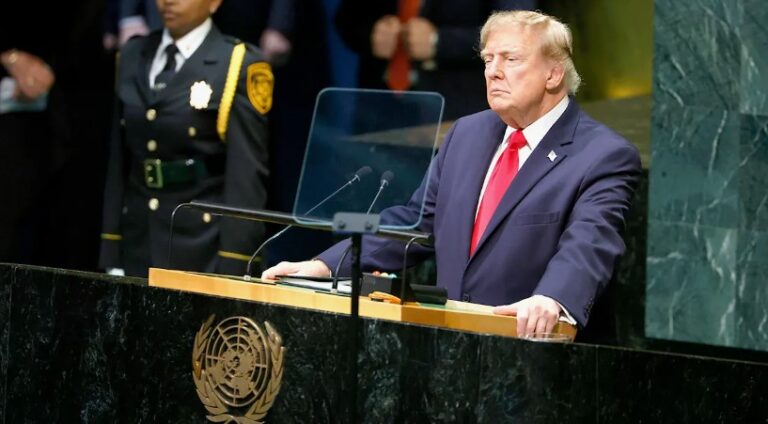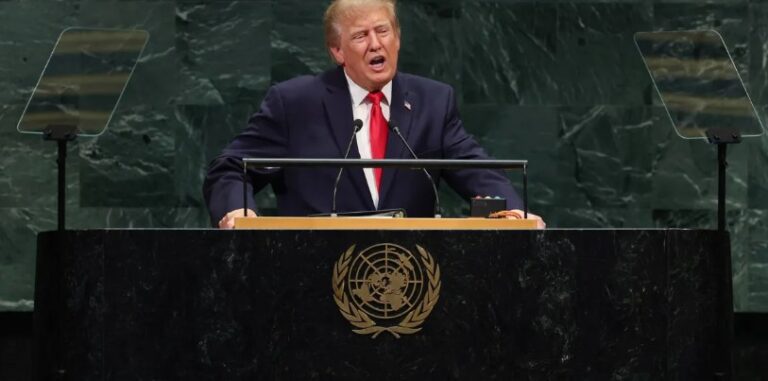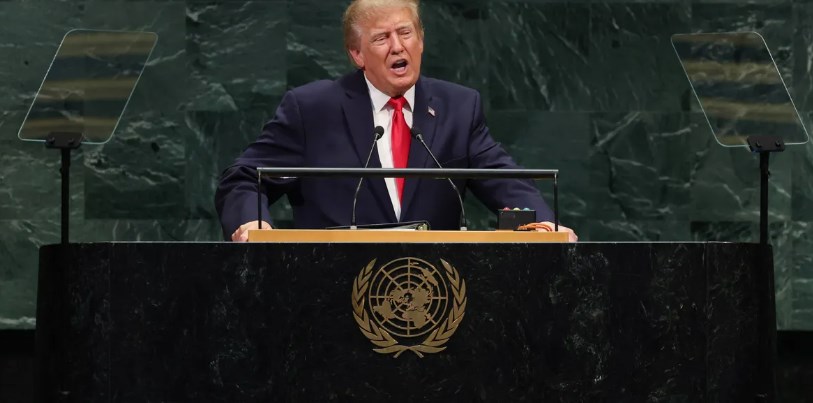
Trump threatens Iran, predicts Cuba’s fall. Key UN takeaways – President Donald Trump used his address to the United Nations General Assembly on September 22, 2026, to deliver a forceful message about American power, Iran, Cuba, Venezuela, Ukraine and the future of global diplomacy. Rather than focusing primarily on traditional appeals for international cooperation, Trump devoted much of his speech to defending U.S. military action and warning countries that Washington was prepared to use its power when it believed American interests were threatened.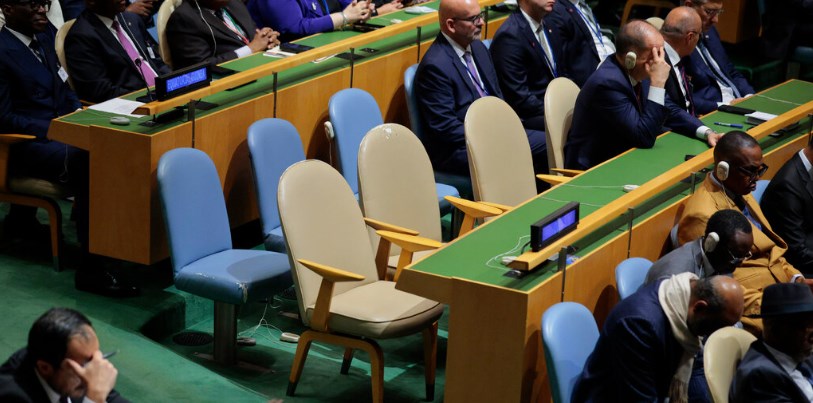
The most striking moments centered on Iran and Cuba. Trump warned that Iran faced a stark choice between reaching an agreement with the United States and facing much more severe military action. He also predicted that Cuba’s communist government would eventually fall, describing the country as a failed state. His comments prompted both Iranian and Cuban delegates to leave the General Assembly during portions of the speech.
The speech offered a revealing look at how the Trump administration is approaching international conflicts in 2026. It combined threats, negotiations, economic pressure and claims of American strength, while also touching on artificial intelligence, drug cartels, Venezuela and the role of the United Nations.
Iran Takes Center Stage
Iran was clearly the most consequential issue in Trump’s address. The president defended the U.S.-Israeli military campaign against Iran and argued that Washington had acted because previous diplomatic efforts had failed to resolve concerns about Iran’s nuclear program and regional activities. Trump said he had a major decision ahead: whether to reach a deal with Tehran or take dramatically more destructive action.
His language toward Tehran was unusually severe. Trump publicly raised the possibility of annihilating the Islamic Republic if an agreement could not be reached, while simultaneously saying that a negotiated settlement remained possible. That combination was one of the central contradictions of the speech: the president presented diplomacy as an available path while making clear that military escalation remained on the table.
Trump also suggested that a deal could come after the November 3 U.S. midterm elections. Later, however, he said the United States and Iran would get the issue resolved quickly “one way or the other.” The conflicting timing illustrated the uncertainty surrounding the diplomatic process.
Iran’s position remains fundamentally different from Trump’s characterization. Iranian officials have repeatedly rejected the claim that Tehran is seeking a nuclear weapon, and the Iranian delegation’s departure from the chamber during Trump’s remarks underscored the depth of the disagreement between the two governments. For countries watching from outside the conflict, the consequences are broader than the U.S.-Iran relationship. The war has affected energy markets and raised concerns about regional security, while the possibility of further escalation continues to carry implications for global trade and oil prices.
Trump’s Prediction About Cuba
Cuba became another major focus of Trump’s speech. He said his administration was seeking “a fundamental change” in the situation on the island and described the Cuban government as a failed state. Trump predicted that the communist government would fall and said that freedom would eventually come to Cuba. The remarks came as Washington continues to apply significant pressure on Havana. According to Reuters, the United States has maintained its trade embargo against Cuba for more than six decades, while the Trump administration has increased pressure on the Cuban government during 2026. Trump also said Secretary of State Marco Rubio was involved in negotiations with Havana.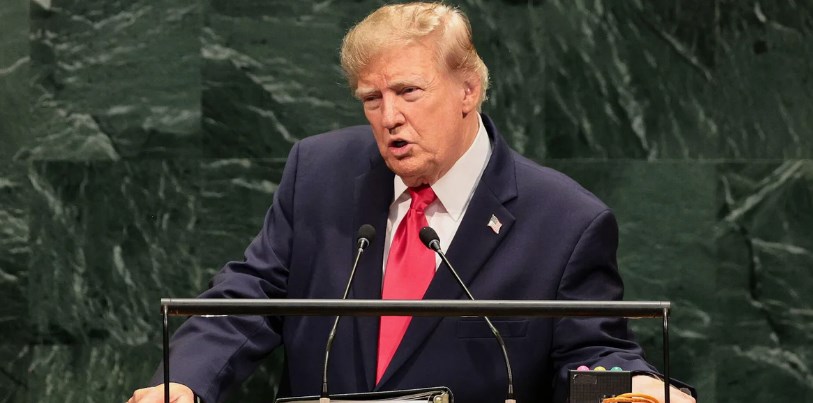
The Cuban delegation responded visibly by walking out of the General Assembly during Trump’s remarks. That moment transformed what could have remained a rhetorical exchange into a highly visible diplomatic confrontation inside the UN chamber. Trump’s comments also linked Cuba to his broader approach to the Western Hemisphere. He argued that the United States should not permit foreign adversaries to establish a foothold close to American territory. His administration has simultaneously emphasized closer U.S. involvement in Venezuela and stronger action against drug-trafficking organizations operating in the region. Whether Cuba actually undergoes the political transformation Trump predicted remains an open question. His statement was a prediction and an expression of U.S. policy objectives, not an established outcome.
Venezuela and a More Assertive Western Hemisphere Policy
Another important part of the speech was Trump’s discussion of Venezuela. He portrayed U.S. involvement there as an example of American power being used to protect what his administration considers vital national interests. Trump highlighted cooperation with Venezuelan interim leader Delcy Rodriguez and referred to an oil agreement involving the United States. He also argued that Washington would no longer tolerate threats gaining a foothold in the Western Hemisphere.
The Venezuela discussion connected directly to Trump’s broader foreign-policy message. Throughout the speech, he emphasized that the United States was prepared to act rather than wait for international institutions or lengthy diplomatic processes. That approach represents an important theme of the administration’s foreign policy in 2026: negotiations remain possible, but military and economic pressure are presented as tools that can be used alongside diplomacy.
Trump also discussed the fight against drug cartels, saying his administration had designated several organizations as terrorist groups and was using military resources against them. His comments demonstrated how his administration increasingly frames organized crime and drug trafficking as national-security issues rather than solely law-enforcement problems.
Ukraine, AI and the Future of American Power
Although Iran and Cuba generated the most dramatic moments, Trump also addressed several other major international issues. On Ukraine, he said the United States was working with both Russia and Ukraine and expressed confidence that progress could be made. He did not provide a detailed roadmap for ending the war, but his comments suggested that negotiations remained an important part of his approach.
Trump also devoted significant attention to artificial intelligence. He argued that the United States should encourage rapid technological development and said he preferred the term “super intelligence” to artificial intelligence. He presented technological leadership as an increasingly important component of geopolitical competition, particularly between the United States and China.
His comments reflected a broader argument running through the speech: American economic, military and technological strength should be used to maintain U.S. influence around the world. At the same time, Trump’s approach to international institutions remained critical. He attacked what he described as excessive influence by international organizations and argued that the United Nations needed significant reform. He also criticized the International Criminal Court and called on member states to withdraw.
What the UN Speech Revealed
Perhaps the clearest takeaway from Trump’s address was that his administration views American power as the foundation of its foreign policy. Iran was presented with the possibility of diplomacy or extreme escalation. Cuba was portrayed as a government under increasing pressure and heading toward eventual change. Venezuela was cited as evidence that Washington was willing to act directly in the Western Hemisphere.
Yet the speech also showed that military pressure and diplomacy are not necessarily separate strategies in Trump’s approach. Even while threatening Iran with devastating consequences, he continued to discuss the possibility of a negotiated settlement. After the speech, Trump struck a somewhat softer tone, saying that he believed a settlement with Iran could eventually be reached.
The response inside the UN chamber highlighted the divisions surrounding his policies. Iranian and Cuban delegates walked out, while UN Secretary-General António Guterres used his own address to emphasize that military power alone cannot guarantee peace. Ultimately, Trump’s UN appearance was less about presenting a single diplomatic doctrine than about demonstrating the range of tools he says the United States is willing to use. Military force, economic pressure, negotiations, sanctions and technological competition all featured prominently.
For the international community, the key question is what happens after the rhetoric. Trump’s statements have raised the stakes with Iran and Cuba, but the outcomes will depend on negotiations, decisions by other governments and developments on the ground. The UN speech made those tensions highly visible; resolving them will require actions far beyond the podium in New York.
About the Author