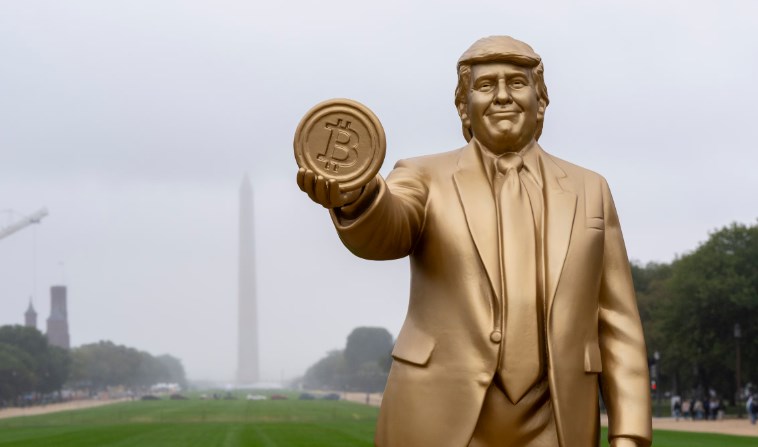
New Trump statue in DC mocks his draft deferment for bone spurs – A new statue of President Donald Trump has appeared in Washington, D.C., just days before Veterans Day, and its message is anything but a traditional tribute. The gold-painted sculpture shows Trump sitting on a pedestal, grimacing as he examines his bare right foot. Its unusual pose is a pointed reference to the bone spurs diagnosis that allowed him to receive a medical deferment from military service during the Vietnam War.
Titled “The Foot Soldier,” the installation turns a long-running controversy surrounding Trump’s military record into a piece of public political satire. Rather than celebrating the president as a military leader, the artwork invites visitors to consider the contrast between his history of avoiding the Vietnam-era draft and his current position as commander in chief.
The sculpture appeared on the National Mall on November 9, two days before Veterans Day. Created by an anonymous art collective known as The Secret Handshake, it quickly attracted attention from tourists, photographers, and people passing through the area.
Its timing is particularly significant. Veterans Day is intended to honour Americans who have served in the armed forces, making the statue’s sarcastic message about military service impossible to miss. <Cite refs={[“turn433494search0″,”turn433494search1″,”turn433494search2”]}/>
The Foot Soldier takes aim at Trump’s military history
The statue depicts Trump seated on a granite pedestal, holding and examining his right foot with an uncomfortable expression. The gold finish gives the installation the appearance of a traditional commemorative monument, but the pose and accompanying plaque quickly reveal its satirical purpose.
The plaque begins with what appears to be a formal tribute to the president’s service and sacrifice. It then turns sharply ironic, describing Trump as a “soldier in spirit” who supposedly marched to the front lines of avoiding the draft with the help of a bone spurs diagnosis.
The inscription continues with another joke about sacrifice, suggesting that when Trump was called to stand up, he chose instead to sit down and rest his feet. The wording deliberately imitates the language often used in military memorials, making the contrast between the traditional format and the political criticism even more striking.
A second inscription includes a quote attributed to Trump from a 2013 Facebook post: “I can be very military.” The line adds another layer to the artwork, connecting Trump’s own public comments about military life with the controversy surrounding his decision not to serve during the Vietnam War.
For the artists, the statue is not simply about a medical diagnosis. It is about the political symbolism of military service, sacrifice, and the responsibilities associated with leading a country whose armed forces are deployed overseas.
The story behind the bone spurs controversy
Trump received five deferments during the Vietnam War era. Four were educational deferments connected to his studies at Fordham University and the University of Pennsylvania. The fifth was a medical deferment granted in 1968 after a diagnosis of bone spurs in his heels. New Trump statue in DC mocks his draft deferment for bone spurs
The medical exemption allowed him to avoid military service during a period when the United States was deeply involved in the Vietnam War. The diagnosis has remained a subject of public debate for decades, particularly because questions have been raised about how it was obtained.
A 2018 report by The New York Times examined the circumstances surrounding the diagnosis and reported that the podiatrist who identified the condition had been a tenant of Trump’s father, Fred Trump. Michael Cohen, Trump’s former personal lawyer, also alleged in 2019 that the diagnosis had been arranged to help Trump avoid military service.
Those claims have contributed to continuing criticism of Trump’s military record. However, the medical deferment itself was an official part of his draft history, and the broader debate concerns the circumstances surrounding the diagnosis and the fairness of the system.
The Foot Soldier brings that history back into public view through a deliberately exaggerated image. By focusing on Trump’s foot rather than presenting him in a heroic military pose, the artists turn a decades-old controversy into a highly visible political statement.
A giant toe mascot makes the installation even stranger
The statue is not the only unusual part of the display. Visitors have also encountered a six-foot mascot dressed as a giant toe, complete with a visible bone-spur detail. The character, named Toey, provides a live and interactive element to the installation.
According to the organisers, Toey is meant to celebrate Trump’s unusual history with military service while drawing attention to the medical explanation that kept him out of the Vietnam War. The mascot reportedly jokes with visitors and encourages them to use the phrase “draft dodger” when posing for photographs.
The addition gives the installation a more theatrical atmosphere. Instead of functioning as a conventional sculpture that people simply walk past, the display becomes a public performance that invites participation.
Tourists and passersby have stopped to photograph the statue and interact with the mascot. Reactions have varied, but the artwork has generated conversation about the relationship between political protest, public art, and the use of humour to challenge powerful figures.
The artists appear to understand that a striking image can travel much farther than a traditional political statement. Photographs of a golden Trump examining his foot, accompanied by a giant toe mascot, are likely to attract attention both in Washington and across social media.
The Secret Handshake’s history of political satire
The Secret Handshake is an anonymous art collective known for creating provocative installations targeting Trump and his administration. The group has previously placed more than a dozen satirical works around Washington, often using familiar monuments, public figures, and popular culture to communicate political criticism. Earlier installations included a sculpture portraying Trump holding hands with Jeffrey Epstein, as well as another that recreated the famous bow-of-the-ship scene from the movie Titanic. Other works have mocked Trump’s White House renovations and his administration’s approach to the war involving Iran.
The collective’s approach is recognisable: create an image that looks like a public monument, then use its subject and accompanying text to challenge the political message normally associated with such memorials. The artists have also maintained their anonymity, using an intermediary to obtain permits for their installations. That arrangement allows the group to stage public works without making the individual creators the centre of attention.
With The Foot Soldier, the collective has returned to a subject that has followed Trump throughout his political career. This time, however, the installation is especially closely tied to Veterans Day and the wider debate over military service.
White House pushes back against the artwork
The installation has also drawn a response from the White House. Spokesperson David Ingle dismissed the artists behind the statue, describing them as Democratic activists affected by what the administration called “Trump Derangement Syndrome.”
The response reflects the political divide surrounding Trump’s public image. Supporters may see the statue as another example of opponents using personal attacks to undermine the president, while critics view it as a legitimate form of political expression aimed at a powerful public official.
The artists, meanwhile, have explained that the work is intended to highlight the contrast between Trump’s military history and his current role in decisions involving American military power. Their criticism is particularly focused on the fact that the president can now make decisions affecting service members despite never having served in the armed forces himself.
This disagreement is part of a broader debate about how political leaders should be judged. Military service is not a legal requirement for becoming president, but a leader’s attitude toward military sacrifice can remain an important subject of public discussion.
Why the Veterans Day timing matters
Placing The Foot Soldier on the National Mall shortly before Veterans Day gives the artwork a meaning that goes beyond its immediate joke. The holiday is an opportunity to recognise the people who served in the US military, including those who experienced the dangers and hardships of war.
The statue deliberately borrows the visual language of military memorials. Its gold finish, granite pedestal, formal plaque, and title all suggest an official monument. Yet its message reverses the usual meaning of a tribute by focusing on a controversial decision not to serve.
For some visitors, the installation is a humorous political protest. For others, its timing may feel disrespectful to the seriousness of military service. That tension is part of what makes the artwork politically provocative.
The statue was scheduled to remain on the National Mall through November 11, Veterans Day. The Toey mascot was also expected to appear intermittently during daylight hours, giving visitors an opportunity to interact with the installation before it was removed. New Trump statue in DC mocks his draft deferment for bone spurs
Public art becomes another political battleground
Washington has long been a place where public monuments communicate ideas about national identity, history, and political power. Traditional statues generally celebrate presidents, military leaders, and historical figures. Satirical installations challenge that tradition by using familiar monumental forms to question the people being represented.
The Foot Soldier fits into that tradition of political protest, although its humour is deliberately direct. It does not attempt to hide its criticism behind complicated symbolism. The foot, the bone-spur reference, the sarcastic plaque, and the toe mascot all point toward the same controversy. New Trump statue in DC mocks his draft deferment for bone spurs
Its location near the National Gallery of Art also places the work in a setting where visitors are already accustomed to encountering sculpture and public installations. That makes the contrast between conventional art and political satire particularly noticeable.
The installation also demonstrates how temporary public art can become part of a much larger national conversation. A sculpture that might otherwise be seen by people walking through Washington can quickly reach audiences across the country through photographs, television coverage, and online discussion.
A small statue with a much bigger political message
The new Trump statue may look humorous at first glance, but its message touches on a long-running question about leadership, privilege, and military responsibility. By revisiting the president’s Vietnam-era deferment, The Foot Soldier challenges the way political leaders discuss sacrifice while making decisions that can put other people in danger.
The artwork does not settle the historical debate surrounding Trump’s medical exemption. Instead, it uses that history as the foundation for a pointed public criticism. Its creators want visitors to think about the difference between avoiding military service and later holding the authority to direct the country’s armed forces.
Whether people find the statue funny, offensive, or politically meaningful, it has achieved one important goal: attracting attention to a subject that continues to follow Trump.
As Washington prepares to mark Veterans Day, The Foot Soldier offers a deliberately unconventional contribution to the conversation about military service. Its golden figure and giant toe mascot may be temporary, but the political argument behind them is likely to remain part of the debate surrounding Trump’s presidency.
About the Author