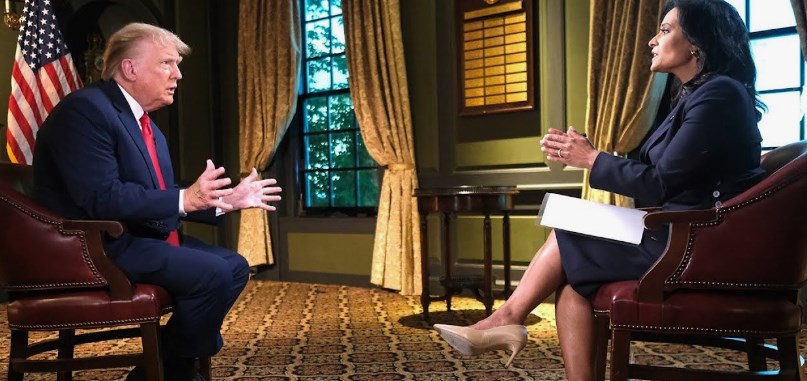
Donald Trump ends tense ‘Meet the Press’ interview, walks away from host – A high-pressure Sunday morning interview took an unexpected turn when Donald Trump abruptly ended his appearance on Meet the Press, leaving the studio moments before the segment was scheduled to conclude. The exchange, which began as a familiar political back-and-forth, quickly escalated into a visibly tense confrontation between the former president and moderator Kristen Welker, culminating in Trump standing up mid-segment and walking off set.
The moment instantly became one of the most talked-about political media incidents of the week, raising fresh questions about the increasingly adversarial tone of televised political interviews in an already polarized election cycle.
A familiar format turns sharply confrontational
The interview began in typical fashion. Hosted by Kristen Welker, the conversation focused on familiar themes: immigration policy, economic performance, and ongoing legal challenges facing Trump as he remains a central figure in American politics.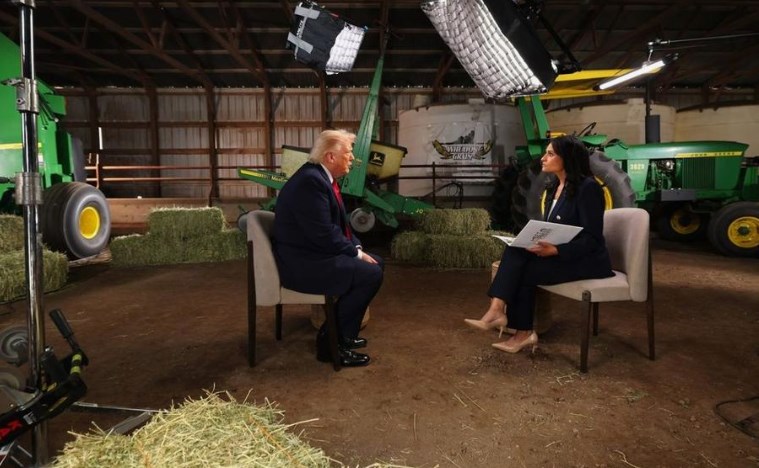
For the first several minutes, Trump appeared composed, leaning into his usual messaging about economic strength during his presidency and criticism of current administration policies. However, the tone shifted when Welker pressed him on recent legal developments and campaign rhetoric, particularly statements critics have labeled inflammatory.
The questioning intensified when Welker referenced specific allegations and court proceedings, asking Trump to clarify contradictions between his public statements and legal filings. Trump pushed back forcefully, accusing the host and the network of bias, repeatedly characterizing the interview as “unfair” and “hostile.”
Rising tension in the studio
As the discussion continued, the back-and-forth grew sharper. Trump interrupted several questions, insisting that the framing of the interview was skewed. Welker, maintaining her composure, attempted to steer the conversation back to specific topics, but the exchange became increasingly difficult to control.
Viewers familiar with Trump’s media appearances noted that while he often clashes with interviewers, this exchange carried an unusually abrupt edge. At one point, Trump reportedly leaned forward, gesturing emphatically as he rejected the premise of a question about his political future and legal vulnerabilities.
The studio audience, though limited in a controlled broadcast environment, remained silent as the tension escalated. Producers in the control room appeared to prepare for a possible cutaway as the conversation became less structured.
The walk-off moment
The turning point came when Welker pressed Trump on whether he would accept the outcome of future elections regardless of legal outcomes and ongoing investigations. After a brief exchange, Trump paused, removed his microphone, and stood up.
Without waiting for a commercial break or formal conclusion, he exited the set, stating that the interview had “gone on long enough under these conditions.” He then walked off-camera, leaving Welker and the production team momentarily to close the segment without the intended conclusion. The broadcast quickly transitioned to a brief buffer segment before returning to scheduled programming. While the show maintained professional continuity, the abrupt departure overshadowed the remainder of the episode. Donald Trump ends tense ‘Meet the Press’ interview
Media reaction and political implications
Within minutes, clips of the walk-off circulated widely across social media platforms, generating millions of views and sparking debate about the state of political journalism in the United States. Supporters of Trump argued that the interview reflected what they view as persistent media antagonism toward the former president. Critics, meanwhile, described the moment as an avoidance of accountability during a high-stakes political conversation.
Media analysts noted that while tense interviews involving Trump are not uncommon, physically leaving a live interview before completion is relatively rare for a figure of his prominence. The moment was quickly framed by commentators as symbolic of broader tensions between political leaders and the press in a deeply divided media environment. Representatives from NBC News issued a brief statement acknowledging the unexpected conclusion of the interview but emphasized that the network maintains its commitment to “rigorous, fair, and balanced political reporting.”
A pattern of confrontational media moments
Trump’s relationship with mainstream media outlets has long been marked by conflict, with repeated accusations from him that journalists misrepresent his positions. Conversely, reporters and editors have frequently defended aggressive questioning as necessary for accountability, particularly given the scope and influence of presidential politics.
This latest incident fits into a broader pattern of increasingly combative political media engagements, where interviews often become battlegrounds for competing narratives rather than structured policy discussions. Analysts suggest that this shift reflects both the polarization of the political landscape and the strategic incentives for political figures to challenge hostile framing in real time. Donald Trump ends tense ‘Meet the Press’ interview
The host’s response
Kristen Welker resumed the broadcast after the interruption, maintaining professionalism as she addressed viewers and transitioned to planned segments. Sources close to production indicated that while the walk-off was unexpected, the team had anticipated the possibility of heightened tension given the topics scheduled for discussion. Welker did not immediately comment publicly beyond her on-air handling of the situation, though colleagues described her response as composed under pressure.
Broader fallout and public debate
In the hours following the interview, political commentators across cable news networks dissected the exchange from multiple angles. Some argued that Trump’s exit demonstrated frustration with what he perceives as unfair media treatment, while others suggested it reflected a reluctance to engage with difficult questions. Donald Trump ends tense ‘Meet the Press’ interview
The incident also reignited discussions about whether political interviews have become too adversarial to produce meaningful policy dialogue. Some analysts argued that both journalists and politicians increasingly approach interviews as performance spaces rather than forums for information exchange. Meanwhile, supporters of Trump framed the walk-off as a rejection of what they see as biased questioning, portraying it as a refusal to “play along” with what they describe as scripted media narratives.
What comes next
As the political season intensifies, moments like this are likely to continue shaping public perception. The intersection of media strategy, political branding, and live broadcast unpredictability creates an environment where unscripted moments can quickly dominate news cycles.
For Donald Trump, the incident will likely be absorbed into an already extensive archive of contentious media appearances. For Meet the Press, it underscores the ongoing challenge of conducting high-stakes political interviews in an era where every exchange is instantly dissected and amplified. Donald Trump ends tense ‘Meet the Press’ interview
Whether viewed as a breakdown in journalistic decorum or a calculated political stance, the walk-off ensured one thing: the interview achieved far more attention than a standard Sunday segment ever would have. And in today’s media landscape, that attention—regardless of how it is generated—may be the most powerful outcome of all.
About the Author