Democrats float 25th Amendment commission for Trump – As some Democrats consider creating a commission to assess former President Donald Trump’s suitability for office, the notion of invoking the 25th Amendment has once again come up in American political debate. Although these conversations are not wholly novel, their resurgence is indicative of the continued divisiveness in American politics as well as persistent worries about responsibility, leadership, and constitutional safeguards against presidential incapacity. Even though it is still mainly symbolic, the proposition itself has generated heated discussion among constitutional scholars and across party lines.
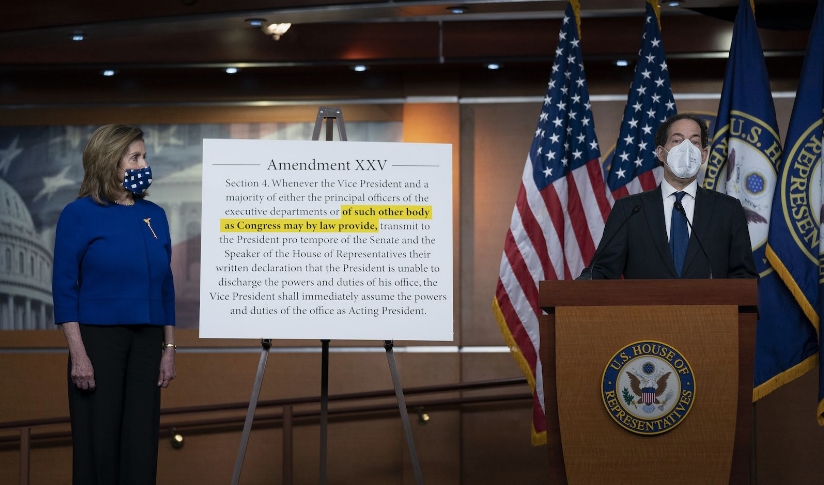
The 25th Amendment to the US Constitution, which was enacted in 1967 following the assassination of President John F. Kennedy, is at the core of the discussion. The amendment specifies how a president who is unable to carry out the responsibilities of the position can be replaced or temporarily relieved. In specifically, Section 4 permits the president to be deemed incompetent by the vice president and a majority of the cabinet or another body chosen by Congress. The idea of establishing a nonpartisan committee that could act as that “other body” is where the current Democratic proposal comes into play.
The proposal’s proponents contend that the panel would offer a methodical, less contentious way to assess presidential fitness. A committee made up of medical professionals, previous officials, and nonpartisan leaders might provide the process credibility and objectivity instead of placing such a significant decision entirely in the hands of political appointees. The goal, according to supporters, is to improve institutional safeguards for the future rather than to target any specific person.
However, it is challenging to distinguish between partisanship and principle given the political backdrop of the proposal. Opponents, especially Republicans, see the action as a blatant attempt to weaken Trump, who continues to be a powerful force in American politics. They contend that bringing up the 25th Amendment outside of a pressing need runs the risk of demeaning a significant constitutional instrument. Additionally, some argue that these conversations could create a risky precedent in which political disputes are reframed as issues of physical or mental health.
The fact that Trump is not in power at the moment complicates the discussion even more. Since a sitting president is specifically covered by the 25th Amendment, any commission created today would not have direct control over him until he were to retake the presidency. This calls into doubt the proposal’s practical ramifications and timeframe. Some commentators see the endeavor as more of a message tactic than a tangible policy push, an attempt to mobilize the Democratic base while drawing attention to leadership issues. Democrats float 25th Amendment commission for Trump
However, there is a precedent for the concept of a 25th Amendment commission. Legislators from both parties have previously indicated a desire to make the amendment’s provisions more clear, especially with relation to the “other body” referenced in Section 4. It has long been believed that a lack of specificity could be a vulnerability, allowing for uncertainty during emergency situations. Democrats are bringing up a long-standing constitutional issue by suggesting a formal commission.
Legal experts are still at odds over the matter. Some contend that careful legislative drafting would be necessary to ensure that the commission’s establishment complies with constitutional standards. Others wonder if Congress even has the jurisdiction to establish a body with the authority that the amendment envisions. Concerns have also been raised regarding the commission’s selection process, decision-making process, and abuse prevention measures.
The plan has received a similarly divided response from the public. There is some support among Democratic voters for investigating methods that would offer more control of the president’s behavior and abilities. In a political era characterized by extraordinary difficulties and disputes, many view it as a constructive move. However, the theory is overwhelmingly rejected by Republican voters and Trump supporters as politically driven, which strengthens their belief that there are continuous attempts to undermine him. Democrats float 25th Amendment commission for Trump
The proposal’s narrative has been greatly influenced by the media. The party gap is frequently emphasized in the coverage, which presents the problem as just another phase in the larger struggle between Democrats and Trump. However, some publications have adopted a more critical stance, looking at the amendment’s historical and constitutional aspects. The intricacy of the problem, which lies at the nexus of politics, law, and public opinion, is highlighted by this dual framing.
The debate raises more general concerns about the durability of democratic institutions in addition to the immediate political ramifications. Although the 25th Amendment was intended to provide protection in exceptional situations, its possible application has come up frequently in recent years. This implies that there is a growing concern regarding the stability of executive leadership and the ways in which it might be addressed. It is still up for debate whether these worries are legitimate or exaggerated, but their continued existence suggests that Americans’ perceptions of presidential accountability are changing. Democrats float 25th Amendment commission for Trump
It’s unclear if the 25th Amendment commission idea will receive any support in Congress going forward. Its destiny will be influenced by partisan dynamics, legislative goals, and the overall political environment. The concept has already added to a crucial discussion about constitutional governance and the checks and balances that support the American system, even if it does not proceed.
The ongoing conflict between institutional integrity and political strategy is reflected in many aspects of the debate. Strengthening constitutional tools to guarantee effective leadership is, on the one hand, a justifiable interest. However, there is a chance that these initiatives will be seen as or utilized as political benefit instruments. It will take careful thought, bipartisan cooperation, and a dedication to the values that the Constitution aims to preserve to strike this balance.
In the end, the plan to create a 25th Amendment commission serves as a reminder of the difficulties involved in running a contemporary democracy. It draws attention to the difficulties of dealing with previously unheard-of situations inside a framework created more than 50 years ago. The debate emphasizes the significance of continuously analyzing and improving the institutions that influence American politics, regardless of whether it is seen as a necessary reform or a partisan ploy. Democrats float 25th Amendment commission for Trump
About the Author