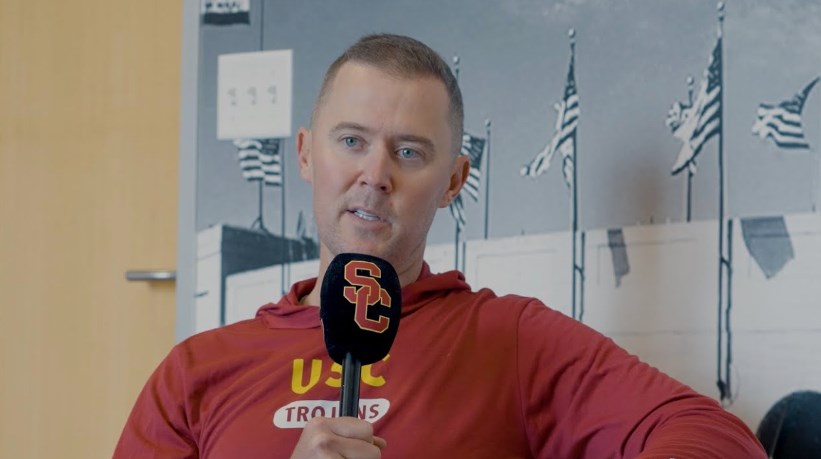
USC football, Lincoln Riley hiring first-of-its-kind director of AI – USC football is once again trying to redefine what a modern college program looks like—not just on the field, but in the way it thinks, plans, and prepares. Under head coach USC Trojans football, Lincoln Riley has never been shy about innovation. From high-powered offensive systems to aggressive recruiting strategies, Riley has built his reputation on staying a step ahead. Now, he’s taking that philosophy into entirely new territory: artificial intelligence.
According to reports, Riley and the USC football program are hiring what is being described as a first-of-its-kind “Director of AI,” a role designed to integrate artificial intelligence into nearly every layer of the program—from game planning and opponent scouting to player development, injury prevention, and even recruiting analytics. It’s the kind of move that feels more Silicon Valley than Saturday night in the Coliseum. But in today’s college football landscape, those worlds are starting to blend.
A football program thinking like a tech company
The idea behind the new position is not just about using AI as a buzzword. USC is attempting to build an internal system where data is not only collected, but actively interpreted and applied in real time. Think less “film room with charts” and more “adaptive intelligence system that learns tendencies across thousands of plays.”
Lincoln Riley, one of college football’s most offensively creative minds, has long emphasized efficiency. At Oklahoma and now at USC, his teams have been known for fast tempo, quarterback development, and explosive passing schemes. But even the most innovative coaching systems have limits when it comes to processing the sheer volume of modern football data.
Every game produces thousands of data points: formations, pre-snap motions, defensive alignments, player tracking metrics, and situational tendencies. Human analysts can only go so far in sorting and interpreting that information. AI, on the other hand, can sift through it in seconds. That’s where USC’s new direction comes in.
What a “Director of AI” actually does in football
While the title sounds futuristic, the job itself is rooted in practical football needs. The Director of AI is expected to collaborate with coaches, analysts, and strength staff to build machine-learning models that can:
- Break down opponent tendencies across multiple seasons
- Predict likely play calls in specific down-and-distance situations
- Optimize USC’s own play-calling based on success probability models
- Analyze player movement and workload data to reduce injury risk
- Assist recruiting by identifying undervalued athletes based on performance metrics
In short, the goal is to turn raw information into actionable coaching insight faster than ever before. One of the most intriguing aspects of the role is its potential impact on in-game decision-making. College football is still largely driven by instinct, experience, and human interpretation. But imagine a scenario where a coach on the sideline receives real-time suggestions based on thousands of historical comparisons: “This defensive look has a 72% likelihood of blitzing on third-and-medium based on similar formations.” That kind of support doesn’t replace coaching intuition—it sharpens it.
Lincoln Riley’s history with offensive innovation
For Riley, this move is consistent with his coaching DNA. He built his reputation as one of the most innovative offensive minds in football by constantly adapting. At Oklahoma, he helped develop Heisman-winning quarterbacks and fielded offenses that routinely ranked among the best in the country. When he took over at USC, expectations were immediate and massive. The Trojans were expected not only to win, but to do so in a way that matched their historic identity as an offensive powerhouse.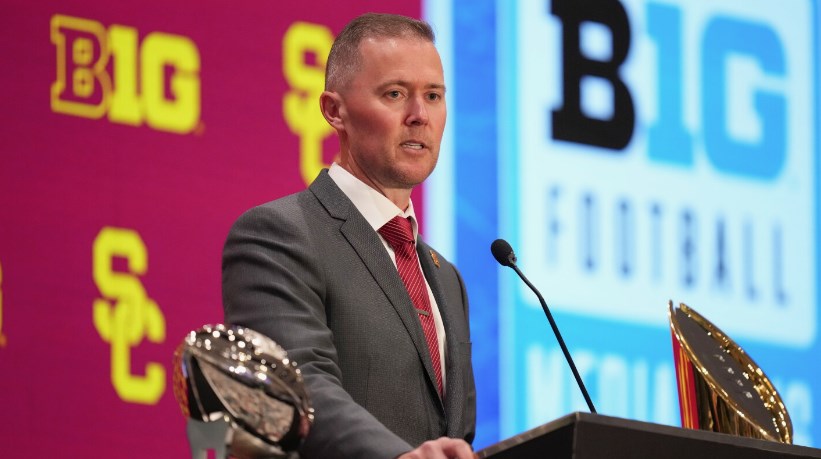
However, competing in the modern era of college football—especially in a new Big Ten environment—requires more than just scheme creativity. It requires infrastructure. This AI initiative suggests Riley understands that evolution. Rather than relying solely on traditional scouting departments and position coaches, USC is effectively building a parallel intelligence layer within the program—one that can continuously process information and feed insights back into football operations. USC football
Why this matters in the broader college football arms race
College football has always been about advantages. For decades, those advantages came in the form of recruiting pipelines, elite coaching staffs, or state-of-the-art facilities. Now, data may be the next frontier. Programs like Alabama, Georgia, Ohio State, and Michigan have already invested heavily in analytics departments. But USC’s decision to formalize an AI-specific leadership role signals a more aggressive leap forward—one that treats artificial intelligence not as a support tool, but as a core strategic asset.
It also reflects a broader trend in sports. The NFL has long used analytics for draft evaluation and game planning. MLB famously embraced “Moneyball” decades ago. Basketball has fully integrated tracking technology at nearly every level. College football, however, has remained more resistant—partly due to tradition, partly due to coaching autonomy. USC’s move suggests that resistance is starting to fade.
The recruiting angle nobody is talking about
One of the less obvious but potentially massive impacts of AI in football is recruiting. High school scouting has always involved subjective evaluation: coaches watching film, attending camps, and making judgments based on athleticism, projection, and competition level. But AI can introduce a more standardized layer of comparison.
Imagine a system that evaluates thousands of high school athletes across the country and normalizes their performance based on competition strength, scheme context, and physical development curves. Suddenly, hidden gems become easier to identify—and overhyped prospects become easier to question.
For a program like USC, recruiting is everything. Competing in Southern California already gives the Trojans access to elite talent, but AI could expand their reach even further, identifying overlooked athletes nationwide who fit their system perfectly. USC football
The human factor still matters
Of course, football is not a computer simulation. No algorithm can fully capture leadership, locker room chemistry, or the emotional swings of a 19-year-old quarterback under pressure in front of 80,000 fans. That’s why USC’s approach is likely to be collaborative rather than replacement-based. The goal is not to hand play-calling over to machines, but to give coaches better information so they can make better decisions.
Lincoln Riley still calls the plays. Position coaches still teach fundamentals. Players still win or lose games on execution. But now, they may do it with a deeper understanding of probabilities, tendencies, and patterns than ever before.
A glimpse into the future of the sport
Whether this experiment becomes a competitive advantage or just another evolving tool remains to be seen. Early adopters of technology in sports often face skepticism—until results make the conversation go away. What is clear, however, is that USC is betting on the future. And Lincoln Riley, known for staying ahead of offensive trends, is once again positioning himself at the center of innovation. USC football
If successful, this could become a blueprint for other programs across the country. Within a few years, “Director of AI” might not be a novelty—it might be a standard part of every major college football staff. For now, though, USC is first. And in college football, being first often means everything.
About the Author