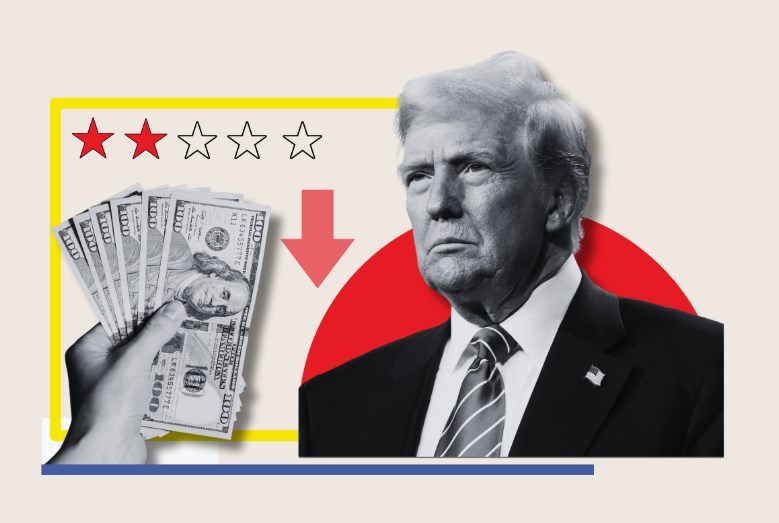
Trump approval rating sinks as Dems lead by double digits – President Donald Trump is entering a critical stretch of his second term with his public approval rating under growing pressure, while several national polls show Democrats opening a substantial advantage in the race for Congress. The latest numbers do not determine what will happen in November, but they provide a clear snapshot of an increasingly unsettled political environment heading into the 2026 midterm elections. Trump approval rating sinks as Dems lead by double digits
A Reuters/Ipsos poll conducted in September found Trump’s overall approval rating at 32%, the lowest level recorded in his political career, according to Reuters. The survey also found that only 17% approved of his handling of the cost of living, while 34% approved of his handling of the conflict with Iran. At the same time, other national surveys show Democrats leading Republicans by double digits on the generic congressional ballot. A September Marquette Law School poll found Democratic congressional candidates ahead 54% to 41% among likely voters, a 13-point difference. Those numbers put the political spotlight squarely on Trump’s relationship with voters as Republicans prepare to defend their congressional majorities.
Trump’s Approval Problem Is Closely Connected to the Economy
For much of Trump’s political career, economic issues have been central to his appeal. His message has frequently emphasized lower costs, stronger domestic production and policies intended to protect American workers. But the latest polling indicates that economic concerns are becoming a significant source of dissatisfaction. The Reuters/Ipsos survey found particularly weak ratings for Trump’s handling of the cost of living. Just 17% of respondents approved of his performance in that area. The same poll reported that inflation and economic concerns were contributing to dissatisfaction among voters, including some Republicans.
The Marquette poll paints a similar picture. Inflation and the cost of living were identified as the leading issue concern in the survey. Respondents gave Democrats an advantage over Republicans on handling inflation and the cost of living, with 36% choosing Democrats compared with 25% choosing Republicans. Democrats also held advantages on the economy, health care, and Medicare and Social Security. That matters because economic sentiment can influence how voters evaluate the party in power. Even voters who support Trump’s broader political agenda may judge the administration through the everyday experience of grocery bills, gasoline prices, housing costs and household budgets.
Democrats Are Showing a Double-Digit Advantage in Some Polls
The most striking part of the recent polling is not simply Trump’s approval rating. It is the size of the Democratic advantage on the congressional ballot. The Marquette Law School survey conducted September 2-9 found Democrats leading Republicans by 13 percentage points among likely voters, 54% to 41%. Among registered voters, Democrats held an eight-point advantage, 50% to 42%. The likely-voter sample included 581 respondents and had a margin of error of plus or minus 4.3 percentage points.
Another Economist/YouGov poll conducted September 11-14 also found a double-digit Democratic advantage among likely voters. Democrats received 51% of the congressional vote preference compared with 39% for Republicans, an 11-point margin. The same survey found that 36% of U.S. adult citizens approved of Trump’s job performance while 59% disapproved. The precise size of the Democratic lead differs from poll to poll. A Reuters/Ipsos survey released earlier in September showed a smaller seven-point Democratic advantage, 44% to 37%. Trump approval rating sinks as Dems lead by double digits
That variation is important. National polling does not translate directly into individual congressional races, and different surveys use different samples, questions and methodologies. Still, several independent polls are pointing in the same general direction: Democrats currently have a stronger position on the national congressional ballot than they had earlier in the year.
Independent Voters Could Be Particularly Important
One of the more revealing aspects of the polling is the behavior of independent voters. The Economist/YouGov survey reported that Democrats held a significant advantage among likely voters, while Republicans performed better among people less certain about voting. That distinction highlights one of the biggest uncertainties surrounding the midterms: who actually turns out. Marquette’s polling also found that independent voters were contributing to the Democratic advantage. Across its six 2026 surveys, non-leaning independents preferred Democratic congressional candidates over Republican candidates by 31% to 14%, although 46% said they preferred neither.
This does not mean independents are permanently moving toward one party. Independent voters can shift considerably depending on candidates, issues, local conditions and the political environment at election time. It does, however, demonstrate why both parties are paying close attention to voters who are not firmly aligned with either side. For Republicans, maintaining strong support among the party’s core voters while reconnecting with independents and less committed voters will be important. Democrats, meanwhile, face their own challenge of turning favorable national sentiment into actual turnout and congressional victories.
Foreign Policy and Iran Are Adding Another Layer
The political environment is not being shaped by domestic economics alone. Trump’s handling of the war with Iran is also affecting public opinion. The Reuters/Ipsos poll found that only 34% approved of Trump’s handling of strikes against Iran. The survey also reported that 82% of respondents expected the conflict to continue for an extended period. Foreign policy can be especially complicated for presidents because public opinion may change as circumstances evolve. Voters may evaluate military action differently depending on casualties, economic consequences, diplomatic developments and whether the administration can demonstrate a clear strategic outcome.
For Trump, the Iran conflict is particularly significant because it intersects with economic concerns. Higher energy costs can affect transportation, household budgets and business expenses, creating a connection between foreign policy and the cost-of-living debate. The administration has defended its approach to Iran, while critics have argued that the conflict has created additional economic and political pressure. These competing interpretations remain part of the broader debate voters will consider. Trump approval rating sinks as Dems lead by double digits
What the Numbers Mean Heading Into November
The latest polling presents a difficult political environment for Trump and Republicans, but it should not be treated as a forecast of the election result. The 2026 midterms are still ahead, and congressional elections are decided district by district rather than through a single national vote. Candidate quality, local issues, fundraising, turnout, campaign organization and developments between now and Election Day can all affect individual races.
The polling nevertheless provides useful information about the current mood. Trump’s approval rating has fallen to historically low levels in some recent surveys, while Democrats have established sizable advantages on the generic congressional ballot. Marquette’s 13-point likely-voter gap and YouGov’s 11-point advantage are among the clearest examples. There are also signs that the political environment remains fluid. Reuters reported that Trump’s approval rating had recently moved from 33% to 35% before falling again to 32% in the subsequent September survey, illustrating how quickly national measurements can change.
For Trump, the central challenge is therefore broader than simply improving a single approval number. His administration faces questions about inflation, the cost of living, foreign policy and other major issues that voters are using to evaluate the direction of the country. For Democrats, a strong national polling position creates its own challenge: maintaining that advantage through Election Day while converting broad dissatisfaction with the governing party into actual votes in individual districts and states.
The latest figures show a political landscape that has become considerably more competitive for Republicans than it appeared at other points in Trump’s second term. But with weeks still remaining before the midterms, the polling should be viewed as a measure of where voters stand now—not a determination of where they will stand when they cast their ballots. Trump approval rating sinks as Dems lead by double digits
About the Author