It’s Donald Trump Versus MAGA on Data Center – The debate over data centers has taken an unexpected turn in the United States. What might once have sounded like a technical discussion about cloud computing, artificial intelligence, electricity and industrial development has become a political issue reaching directly into Republican communities. President Donald Trump has continued to strongly support the expansion of data centers, while some grassroots conservatives and Republican politicians are increasingly questioning what those projects mean for their communities.
That tension is at the heart of the recent debate described by WIRED: Trump has doubled down on artificial intelligence and the infrastructure needed to power it, while parts of his political base are becoming more skeptical. The disagreement is particularly interesting because opposition to data centers is not coming exclusively from traditional environmental groups or Democrats. Some conservative activists are raising concerns about property rights, electricity prices, pollution, water use and the role of large technology companies.
Trump Sees Data Centers as Part of America’s AI Future
For Trump, the argument surrounding data centers is closely connected to the broader competition over artificial intelligence. Modern AI systems require enormous computing resources, and those resources depend on large facilities filled with specialized computer equipment. These facilities consume substantial amounts of electricity and often require significant infrastructure investment.
Trump has repeatedly argued that the United States needs to build this infrastructure quickly rather than allow China to gain an advantage in AI. His administration has therefore promoted policies intended to accelerate data-center construction, including efforts to simplify permitting and encourage development. The White House has also emphasized the economic benefits associated with the industry, including construction, employment, investment and tax revenue.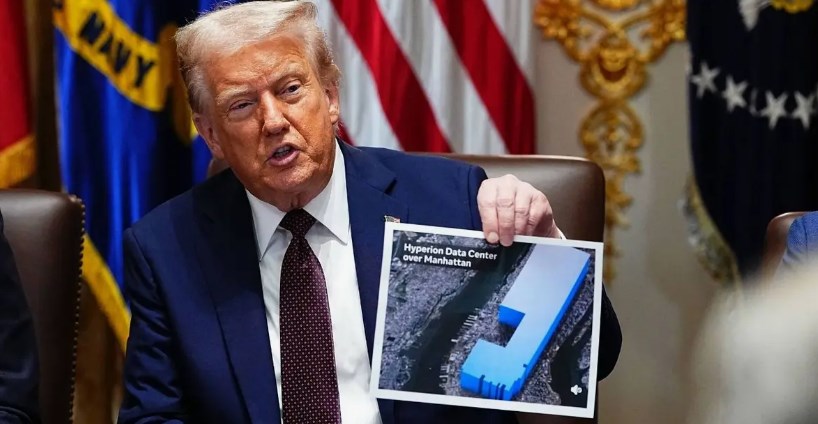
The president has been unusually direct about his position. In August, Trump said that if he were a mayor or governor and had the opportunity to attract a major AI plant or data center, he would want it because of the jobs and tax revenue. More recently, he criticized communities that resist data centers, arguing that refusing such projects could undermine their economic prospects. From that perspective, data centers are not simply warehouses full of computers. They are part of the infrastructure behind an industry that Washington increasingly considers strategically important.
Why Some MAGA Supporters Are Pushing Back
The surprising part of the story is that some of the resistance is coming from people who otherwise strongly support Trump. WIRED highlighted the example of Molly McCann Sanders, a Texas conservative and president of the Eagle Forum Education & Legal Defense Fund. Sanders supports Trump on many issues but has expressed concerns about data-center expansion, particularly environmental effects and property rights. She has argued that communities should move carefully when considering facilities that could have long-term consequences for residents.
That concern reflects a broader shift in the conservative conversation. For years, Republican politics has often emphasized economic growth, limited government, private property and opposition to excessive regulation. Data centers can bring those principles into conflict.
A community may welcome investment and new jobs but still worry about who pays for additional power infrastructure. Residents may support private property rights while objecting to projects that require new transmission lines or other infrastructure. Conservatives who favor local control may also question decisions made by state or federal authorities that affect their towns. In other words, opposition to data centers does not necessarily fit neatly into the traditional left-versus-right political framework.
Electricity Bills Have Become a Major Concern
One of the most practical concerns involves electricity. Data centers can consume enormous quantities of power, particularly facilities designed to support AI workloads. When multiple projects arrive in the same region, utilities may need to expand generation, transmission and distribution infrastructure. That creates a difficult question: who should pay for those upgrades? It’s Donald Trump Versus MAGA on Data Center
Consumers are increasingly worried that they could end up carrying part of the cost through higher electricity rates. That concern has become significant enough to produce bipartisan congressional action. On September 16, the U.S. House passed the Ratepayer Protection Act by a 417–3 vote. The legislation would require state utility regulators to consider whether large electricity users, including data centers, should cover additional infrastructure costs associated with their demand.
The issue is also something the Trump administration has acknowledged. In July, Trump expanded a voluntary pledge involving governors and electricity companies intended to protect consumers from higher utility bills associated with data-center growth. The pledge reflected the growing sensitivity around the relationship between AI expansion and household energy costs.
That does not mean every data center will automatically increase electricity bills. The actual impact depends on local utility structures, available generation, infrastructure investments and how costs are allocated. But the concern has become difficult for politicians to ignore.
Water, Land and Neighborhood Concerns
Electricity is only one part of the controversy. Large data centers can require substantial cooling systems, which can increase water consumption depending on the technology used and the local climate. They also occupy large areas of land and can transform rural or suburban landscapes. Noise from cooling equipment and other mechanical systems has become another complaint in communities located near large facilities. It’s Donald Trump Versus MAGA on Data Center
These concerns have helped turn data centers from an abstract technology issue into something people can experience in their own neighborhoods. That distinction matters politically. Someone who rarely thinks about artificial intelligence may not care about debates over computing capacity or global technology competition. But that same person may pay attention when a proposed facility is located near their home, when electricity infrastructure needs to be expanded or when local officials discuss zoning and tax incentives. This helps explain why some conservative voters who enthusiastically support technological development can still question individual data-center projects.
A Difficult Position for Republican Candidates
The political challenge is becoming particularly visible ahead of the 2026 midterm elections. Polling cited by WIRED found that more than 60% of Americans, including 47% of Republicans, opposed the construction of data centers. At the same time, the issue is not necessarily the dominant concern for most voters. The same reporting noted that AI and data centers rank relatively low compared with broader economic and political priorities, while a significant share of voters remain unsure which political party would handle the issue better.
That creates a complicated environment for Republican candidates. Supporting Trump’s broader AI agenda may be important to maintaining alignment with the White House, but openly supporting local data-center projects can create problems when residents are worried about electricity prices, water or property.
Texas provides a particularly clear example. Governor Greg Abbott and Republican Attorney General Ken Paxton have taken steps to address concerns about the impact of data centers on electricity demand and communities. Trump subsequently criticized resistance to data centers, illustrating the unusual policy disagreement developing within the Republican Party.
The disagreement does not mean Republicans have reached a single unified position against data centers. Instead, the debate increasingly appears to center on how quickly facilities should be built, who should pay for the infrastructure and what protections communities should receive.
The Bigger Question: Who Benefits From the AI Boom?
At the center of this debate is a simple question: who receives the benefits of the AI boom, and who carries its costs?. Technology companies argue that data centers are essential infrastructure for economic growth, artificial intelligence and American competitiveness. Communities can potentially receive construction activity, jobs, tax revenue and new investment. National policymakers also see computing infrastructure as strategically important.
Residents, however, may look at the same project from a different angle. They may see higher infrastructure requirements, changes to their surroundings, water consumption, noise or concerns about electricity prices. Both perspectives can exist simultaneously. It’s Donald Trump Versus MAGA on Data Center
Trump’s position emphasizes the national economic and technological opportunity. Some members of his political base are emphasizing local consequences and community control. That makes the data-center debate more complicated than a simple argument between technology supporters and technology opponents.
The coming months will show how much influence this issue has on American politics. For now, one thing is clear: the debate over data centers has moved far beyond server rooms and technology companies. It has become a discussion about energy, property, economic development, artificial intelligence and the future of local communities.
And perhaps most significantly, it is producing an unusual political conversation in which Donald Trump and parts of the MAGA movement are no longer necessarily on the same page when it comes to America’s rapidly expanding AI infrastructure.
About the Author