Trump claims he would have won California had Jesus counted the votes – In the grand theater of American politics, few figures can command a microphone quite like Donald Trump. On a breezy Wednesday at Joint Base Andrews, just before boarding a flight to deliver a commencement address at the U.S. Coast Guard Academy, the President reminded the world of his unique talent for blending the hyper-political with the cosmic.
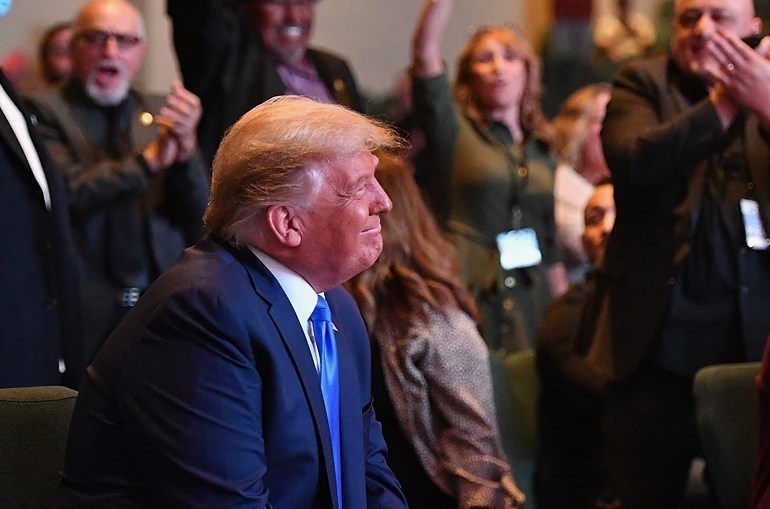
When asked by reporters about a local mayoral race in Los Angeles, Trump quickly pivoted to a grander, much more striking claim: he would have won the deeply Democratic state of California, if only the voting process were overseen by a higher power. The comment, delivered with his trademark mix of casual bravado and intense conviction, instantly caught fire across the political spectrum. It was a classic Trumpian moment—hyperbolic, deeply provocative, and engineered to challenge the conventional boundaries of political discourse. Trump claims he would have won California had Jesus counted the votes
The Root of the Rhetoric: California and Mail-In Ballots
To understand why Trump invoked the ultimate spiritual authority to talk about the Golden State, one must look at his long-standing grievances with its electoral system. California, a state that hasn’t voted for a Republican presidential candidate since George H.W. Bush in 1988, has become the ultimate symbol of the “blue wall” in Trump’s political worldview. Trump specifically took aim at California’s universal mail-in voting system, a policy adopted during the pandemic that sends a ballot to every registered voter in the state.
-
The Mail-In Grievance: “You have all the mail-in ballots, everything else,” Trump told reporters. “Very hard to win because the elections are very dishonest.”
-
The Scale Claim: He alleged that the state mass-distributed ballots without proper oversight, stating, “They sent out 38 million votes. Nobody knows where they’re going.”
-
The “Dishonest States” List: Flushed with political momentum from recent primary victories, Trump even teased the idea of compiling an official ranking of what he deems “dishonest states,” confidently asserting that California would sit near the very top.
For election officials and data analysts, the math tells a starkly different story. In the 2024 presidential election, Kamala Harris carried California by roughly 20 percentage points. Trump’s losses there in previous cycles were even wider—falling to Joe Biden by 29 points in 2020 and Hillary Clinton by 30 points in 2016. Independent audits and state election officials have repeatedly emphasized that there is no evidence of widespread fraud or systemic corruption in California’s voting system. Yet, for Trump, the overwhelming margins are not a reflection of shifting demographics or political preferences, but rather proof of a flawed apparatus.
The Hispanic Vote and the Appeal to Faith
The core of Trump’s argument rests on a very real, highly analyzed political trend: his growing strength among Hispanic voters. Across the country, and particularly in the Southwest, working-class Latino voters have increasingly drifted toward the Republican Party, drawn by economic concerns, immigration policies, and cultural conservatism.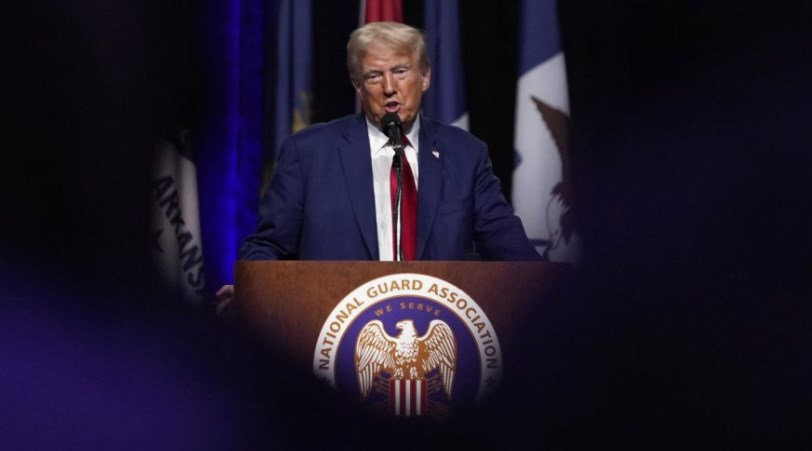
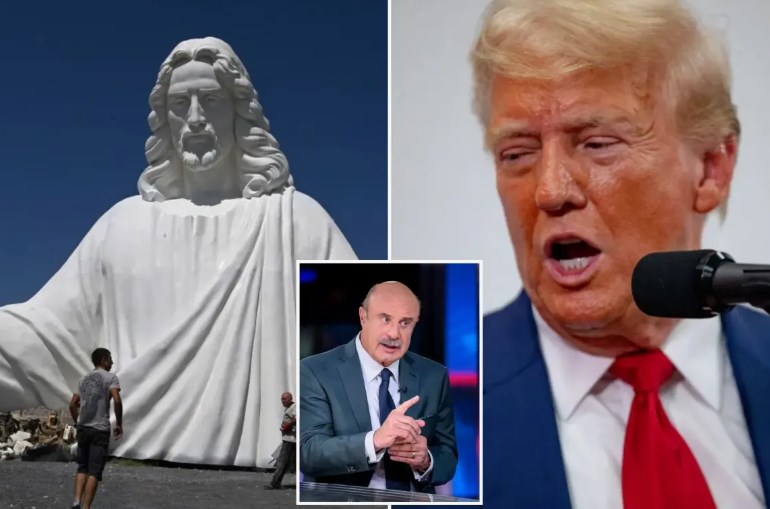
Even within his own party, however, the idea that California is secretly a red state is met with a healthy dose of skepticism. When Trump previously floated a similar “Jesus as the vote counter” theory during a 2024 interview with Dr. Phil, Republican National Committee Chairman Michael Whatley gently pushed back. While acknowledging that California holds millions of conservative voters, Whatley called the idea of a Republican victory there “a little bit of a stretch,” choosing instead to focus on standard party messaging around election security. Trump claims he would have won California had Jesus counted the votes
AI Art, Papal Tensions, and a Growing Religious Focus
Trump’s invocation of Jesus at Joint Base Andrews is not an isolated rhetorical flourish. It comes during a period where the President has increasingly leaned into religious imagery, occasionally blurring the lines between political leadership and spiritual iconography.
Recently, Trump’s social media activity has featured highly stylized, AI-generated images that connect his political battle with divine themes.
-
The Doctor Image: He previously shared (and later deleted) an AI image depicting himself in robes, standing alongside the Statue of Liberty, appearing to heal a sick man. When questioned about it, Trump defended the imagery: “It’s supposed to be me as a doctor making people better, and I do make people better.”
-
The Embrace: On the very same Wednesday as his California comments, Trump posted another AI-generated image, this one showing Jesus Christ placing a supportive hand on his shoulder. Trump captioned it: “The Radical Left Lunatic might not like this, but I think it is quite nice!!!”
This heavily spiritual branding comes at a time of rising friction between Trump and formal religious institutions, most notably the Vatican. Tensions between the White House and Pope Leo XIV have simmered over foreign policy disputes, particularly regarding conflicts in the Middle East involving Israel and Iran.
Following a Palm Sunday address where Pope Leo criticized world leaders who invoke faith to justify warfare—stating that “God rejects the prayers of those who wage war”—Trump fired back publicly. He labeled the pontiff “very liberal,” accused him of being “weak on crime,” and urged the Vatican to “stop catering to the Radical Left.” Trump claims he would have won California had Jesus counted the votes
A Polarized Response to a Cosmic Metaphor
Predictably, Trump’s comments provoked an immediate, highly polarized reaction across the internet and the political landscape. For his loyal base, the comment was classic Trump: a humorous, exaggerated way of pointing out what they believe to be systemic unfairness in blue-state voting laws. To his supporters, the metaphor resonated as a critique of a secular, bureaucratic system that they feel ignores the values of everyday, religious Americans.
For his critics, however, the remarks were viewed as a troubling blend of election denialism and sacrilege. Social media quickly filled with sharp rejoinders. “He is coming down, but I don’t think He’s coming to count votes,” one user remarked. Others criticized the President for using the central figure of the Christian faith as a prop to complain about a political loss from years prior.
Ultimately, Trump’s assertion that Jesus would hand him California serves as a perfect microcosm of his broader political strategy. By elevating a local disagreement about mail-in ballots into a cosmic battle between absolute honesty and systemic corruption, Trump ensures that the debate is never just about politics—it is about faith, loyalty, and identity. Whether one views it as an effective piece of political theater or a step too far, it is a reminder that in Donald Trump’s Washington, the campaign never truly ends, and no metaphor is too big for the stage. Trump claims he would have won California had Jesus counted the votes
About the Author