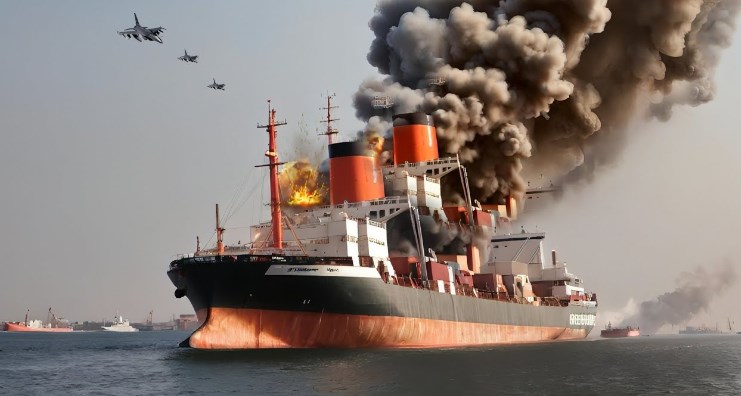
Finland detects drone attack on Russian cargo ship – Quiet autumn mornings in the eastern Gulf of Finland are usually defined by the steady hum of commercial shipping lanes connecting St. Petersburg to the wider world. On Saturday, November 21, 2026, that routine was shattered when Finnish military sensors detected a drone strike against a Russian cargo vessel in international waters, igniting a fire on board and sending the disabled ship drifting toward Finnish territory.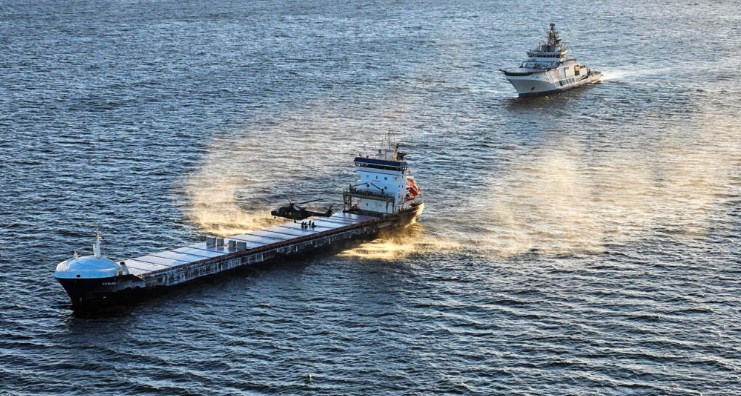
The incident underscores how the front lines of the ongoing war in Ukraine—now deep into its fifth year—continue to stretch far beyond Eastern Europe, bringing the realities of modern drone warfare directly to the doorstep of NATO’s northern flank.
A Morning Strike in Neutral Waters
According to Finland’s Ministry of Defence, the Finnish Defence Forces detected the aerial attack early Saturday morning west of Suursaari, a Russian-controlled island situated in the eastern Gulf of Finland. While the strike occurred in international waters, the crippled ship quickly lost control, caught fire, and began drifting across the maritime boundary into Finland’s territorial waters. Finland detects drone attack on Russian cargo ship
Across the border in Russia, Leningrad Oblast Governor Alexander Drozdenko confirmed that two drones had struck a cargo ship approximately three nautical miles from the Russian coastline. Drozdenko noted that the vessel had been bound for Kaliningrad—Russia’s heavily militarized Baltic exclave wedged between Poland and Lithuania—and that emergency teams had begun evacuating the crew while assessing the extent of the damage.
Regional maritime trackers and Estonian public broadcaster ERR identified the burning ship as the Sparta II, a Russian dry cargo vessel that has previously drawn international scrutiny and U.S. sanctions for its alleged role in transporting weapons and military equipment. Distress alerts from the ship were first logged around 9:35 a.m. local time roughly 11 nautical miles north of Estonia’s Vaindloo Island, highlighting just how tightly packed the maritime geography of the region truly is.
Finland’s Rapid Response and Environmental Containment
Once the burning vessel drifted into Finland’s area of responsibility, Helsinki moved swiftly to manage both the security fallout and the immediate humanitarian and environmental hazards. Units from the Finnish Border Guard were immediately dispatched to the scene to lead maritime rescue efforts and monitor the hull for any potential fuel leaks.
“A Russian cargo ship is on fire in the eastern Gulf of Finland. The Finnish Border Guard is leading the maritime rescue operation and is preparing for potential environmental damage control within Finland’s area of responsibility,” the agency stated in an official release.
In a follow-up update, border officials reassured commercial operators that the burning ship did not pose an immediate collision or navigation hazard to other vessels transiting the busy corridor. Simultaneously, the Finnish Defence Forces imposed temporary restrictions on both airspace and maritime traffic across the eastern Gulf of Finland as a precaution in case additional drones entered the area and required interception. Helsinki also immediately notified its NATO allies of the strike, ensuring coordinated situational awareness across the Baltic region.
Diplomatic Reaction and Growing Regional Tension
While Finland’s Ministry of Defence stopped short of officially naming the party responsible for launching the drones, political leaders in Helsinki were candid about the broader geopolitical context. Writing on the social media platform X, Finnish Prime Minister Petteri Orpo acknowledged the unsettling proximity of the violence while reaffirming Finland’s stance on the broader conflict.
“War is spilling over into our immediate vicinity,” Orpo wrote, adding pointedly that “Ukraine has the right to fight back against the aggressor.”
The strike did not happen in isolation. Throughout the war, Ukrainian and Russian forces have repeatedly targeted each other’s maritime assets, though those clashes were historically concentrated in the Black Sea. In recent weeks, however, long-range Ukrainian drone operations have increasingly reached Russia’s northwestern ports and shipping routes. Earlier in November, Finland’s military detected a separate strike on a Russian warship in the Gulf of Finland—an operation Kyiv later claimed credit for, prompting Helsinki to quietly raise concerns with Ukrainian officials about conducting strikes so close to Finnish waters. Finland detects drone attack on Russian cargo ship
A Strategic Waterway Under Strain
Lying at the easternmost tip of the Baltic Sea between Finland, Estonia, and Russia, the Gulf of Finland is one of Europe’s most sensitive maritime choke points. For Moscow, it serves as a vital economic and military lifeline connecting St. Petersburg and major ports like Ust-Luga to Kaliningrad and global markets. For NATO, which gained both Finland and Sweden as members in the wake of Russia’s 2022 invasion of Ukraine, the Baltic has effectively become a frontline zone marked by heightened surveillance, GPS jamming, and recurring allegations of hybrid warfare. Finland detects drone attack on Russian cargo ship
As Finnish border guards continue working to extinguish the blaze and prevent an oil spill in fragile Baltic waters, Saturday’s incident serves as a stark reminder that modern conflict rarely respects neat geographic boundaries. Even for nations formally at peace, the ripples of a distant war can drift across the horizon at a moment’s notice.
About the Author