Google releases Gemini 4 Neon AI model, rivals Claude Opus 5.5 and GPT-6.2 Sol – The pace of artificial intelligence development in late 2026 has reached a breathless sprint. Just days after OpenAI rolled out GPT-6.2 Sol and months into Anthropic’s reign with Claude Opus 5.5, Google DeepMind has unveiled its latest contender: Gemini 4 Neon. Released on November 18, 2026, Neon enters the market not merely as another incremental update, but as a calculated strike at the industry’s most coveted sweet spot—combining frontier-level reasoning with high speed and aggressive cost efficiency.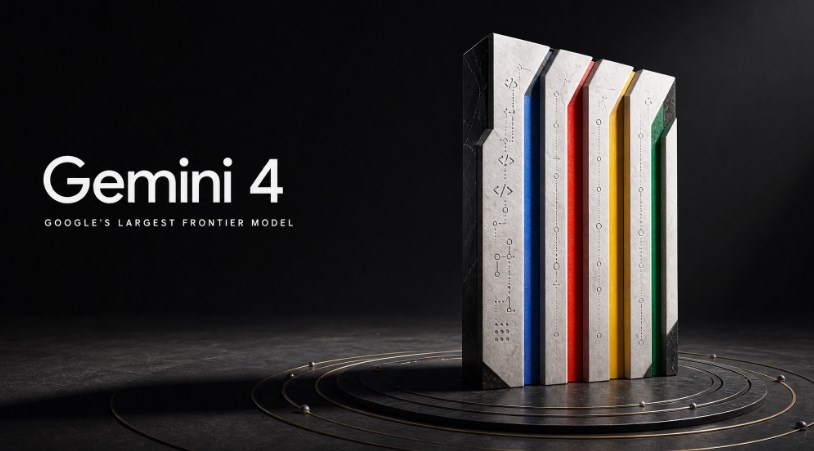
For developers, enterprise leaders, and everyday power users, the arrival of Gemini 4 Neon signals a shift in how leading AI labs compete. Rather than fighting solely over who owns the largest, slowest, and most expensive flagship model, the battle is now centered on practical intelligence: how quickly and affordably a model can complete complex, multi-step tasks in the real world. Google releases Gemini 4 Neon AI model
Filling the Strategic Gap in the Gemini 4 Lineup
To understand what makes Gemini 4 Neon significant, it helps to look at where it sits inside Google’s broader model family. Prior to this release, Google divided its fourth-generation lineup between two extremes. At the top stood Gemini 4 Carbon, a heavy-duty reasoning powerhouse engineered for long-horizon scientific research and deeply complex problem-solving. At the fast, lightweight end sat Gemini 4 Hydrogen, built for rapid, everyday queries and low-latency developer workflows.
Gemini 4 Neon bridges that divide. Adapted directly from the Gemini 4 Carbon architecture, Neon retains deep analytical capabilities while trimming away the latency and token overhead that can make massive models sluggish in production environments. It supports a massive one-million-token unified context window across text, images, audio, and video, allowing users to feed entire codebases, dense financial audits, or lengthy research archives into a single session.
Crucially, Google equipped Neon with four adjustable reasoning effort levels—low, medium, high, and “xhigh”. When pushed to its xhigh thinking mode, Neon engages in deep, multi-step deliberation tailored for demanding engineering, data analysis, and cybersecurity workloads. When dialed back, it operates as a nimble workhorse capable of rapid, high-frequency execution.
Going Head-to-Head with Claude Opus 5.5 and GPT-6.2 Sol
Google’s timing is hardly coincidental. OpenAI launched GPT-6.2 Sol on November 17, 2026, pitching it as a fast, budget-friendly challenger to Anthropic’s Claude Opus 5.5. Less than twenty-four hours later, Google stepped onto the stage with benchmark numbers designed to undercut both rivals.
On the widely tracked Artificial Analysis Intelligence Index, Gemini 4 Neon achieved a score of 61 points, securing the third spot overall on the global leaderboard. In doing so, it edged past Anthropic’s Claude Opus 5.5 at 59 points and OpenAI’s newly minted GPT-6.2 Sol at 57 points. While raw index scores never tell the whole story, the margins highlight how tightly clustered the top tier of AI has become.
In real-world coding and terminal execution, the competition remains razor-thin. On Terminal-Bench 4.1, which tests an AI’s ability to navigate command-line environments and execute live software engineering tasks, Claude Opus 5.5 held onto a slight lead at 65.8 percent, with Gemini 4 Neon trailing by a fraction of a percentage point at 65.2 percent. Where Neon separated itself from the pack was in specialized vulnerability patching and complex engineering logic, where Google reported substantial efficiency gains.
The Economics of Intelligence: Pricing and Efficiency
Perhaps the sharpest weapon in Gemini 4 Neon’s arsenal is its pricing structure. As organizations scale up autonomous AI agents that run thousands of background queries per hour, token costs can quickly spiral out of control. Google priced Neon at $3 per million input tokens and $15 per million output tokens, with cached input tokens discounted by 95 percent to just $0.15.
That places Neon squarely between its two primary competitors:
-
Claude Opus 5.5 sits at the premium end of the spectrum at $4 per million input tokens and $20 per million output tokens, making it the costliest option for high-volume deployments.
-
GPT-6.2 Sol undercuts both on raw token sticker price at $2 per million input tokens and $10 per million output tokens for standard context windows, though its rates double once prompts exceed 272,000 tokens.
-
Gemini 4 Neon offers a flat $3/$15 rate across its full one-million-token context window while using significantly fewer reasoning tokens per task—delivering a 32 percent reduction in cost per task compared to Gemini 4 Carbon and costing over 36 percent less per task than competing frontier models at maximum reasoning settings. Google releases Gemini 4 Neon AI model
Pushing the Boundaries of Agentic Workflows and Cyber Defense
Beyond charts and pricing tables, Google demonstrated Neon’s capabilities through a series of ambitious agentic showcases in Google Antigravity, its agentic development platform. In one standout demonstration, a swarm of Gemini 4 Neon agents transformed a static photograph into an interactive 100,000-cell Google Sheet. Without embedding any images or writing custom scripts, the model generated more than 500,000 live spreadsheet formulas to perform edge detection, map three-dimensional depth, and dynamically relight the scene. In another test, Neon wrote over 10,000 lines of custom shader code from scratch to build a WebGL2 Mont Blanc skiing simulation complete with 120Hz physics and dynamic snow tracks.
Cybersecurity is another major pillar of the release. Google emphasized that Neon excels at defensive security workflows, including automated penetration testing, identifying subtle code vulnerabilities, and generating root-cause patches. On Collinear’s CWE-bench v2 vulnerability patching evaluation, Neon reached a 70.7 percent success rate, outperforming even Google’s heavier Carbon model while consuming half the tokens on exploit discovery benchmarks.
Availability and What Comes Next
Unlike some frontier announcements that remain locked behind waitlists for months, Gemini 4 Neon is immediately accessible across Google’s ecosystem. Developers can integrate it right away via the Gemini API and Google AI Studio, enterprise teams can deploy it through Gemini for Business, and individual subscribers on Google AI Pro and Ultra plans can select it inside the Gemini app and Google Antigravity.
With Gemini 4 Neon, Google has made a compelling argument that the next phase of the AI race won’t be won by brute force alone. By matching or exceeding the intelligence of Claude Opus 5.5 and GPT-6.2 Sol while keeping latency and operational costs firmly in check, Neon sets a demanding new benchmark for what practical, everyday frontier AI looks like. Google releases Gemini 4 Neon AI model
About the Author