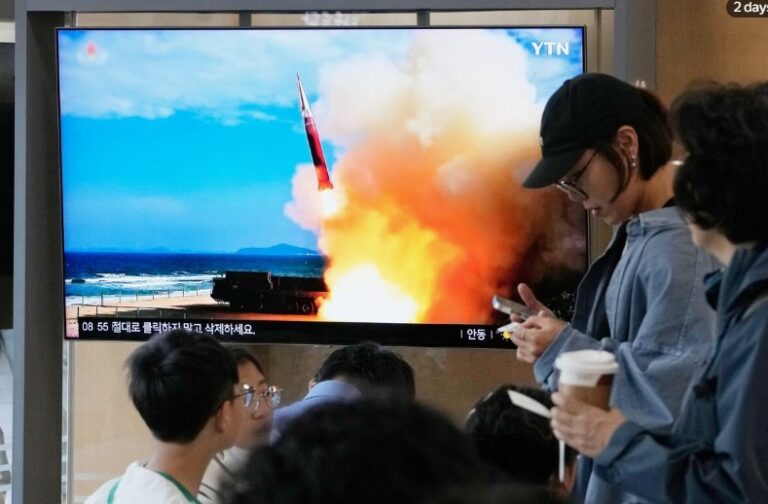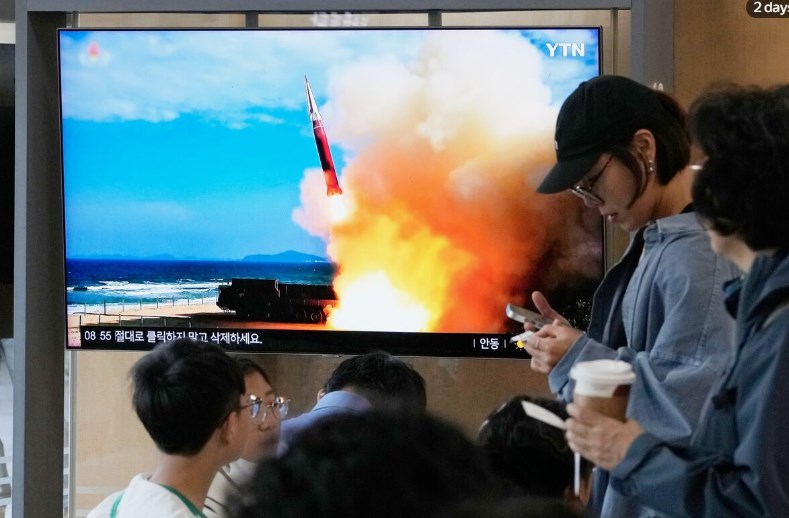
North Korean military fired ballistic missile with integrated AI – North Korea has once again pushed its military technology into the spotlight after test-firing an intermediate-range ballistic missile that Pyongyang claims can maneuver during flight and use artificial intelligence technology to make interception more difficult.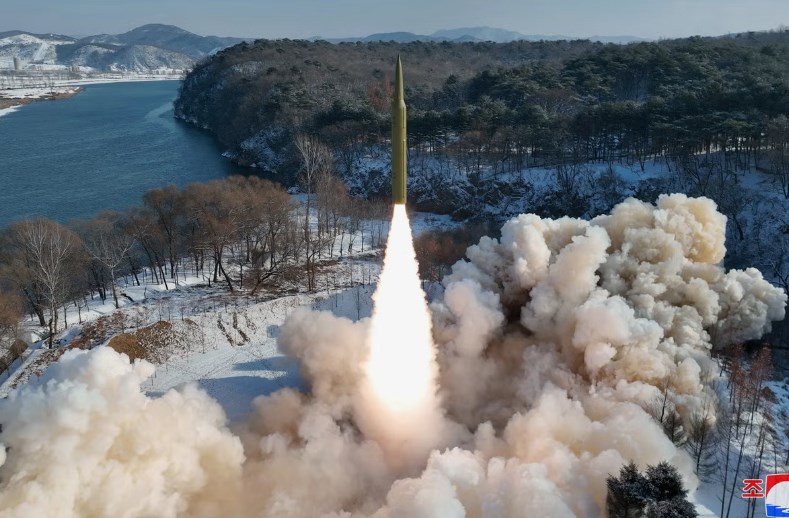
The launch, carried out from North Korea’s eastern coastal area, comes at a particularly tense moment on the Korean Peninsula. South Korea and North Korea have been trading increasingly sharp accusations following a landmine incident near the Demilitarized Zone, while Pyongyang continues to expand and modernize its missile and conventional weapons programs. North Korean military fired ballistic missile with integrated AI
According to South Korean military assessments, the missile traveled more than 700 kilometers toward waters off North Korea’s eastern coast. Japan’s Defense Ministry estimated the distance at roughly 680 kilometers. North Korea, meanwhile, presented the test as evidence of a more sophisticated strategic weapons capability.
What makes this launch especially interesting is not simply the missile’s range. North Korea says the weapon incorporates artificial intelligence and can change its trajectory at lower altitudes, potentially creating a more complicated challenge for existing missile-defense systems. However, those claims remain difficult to independently verify.
A Missile Designed to Be Harder to Predict
North Korea’s description of the weapon suggests that Pyongyang is focusing increasingly on maneuverability rather than relying solely on traditional ballistic missile flight paths. A conventional ballistic missile generally follows a predictable arc after launch, although modern systems can incorporate maneuvering capabilities that complicate tracking and interception. North Korea claims this latest missile can use a so-called wave-like trajectory and make changes to its flight path at relatively low altitude.
Kim Yo Jong, the sister of North Korean leader Kim Jong Un and a senior political figure, said the missile’s maneuvering characteristics exposed weaknesses in the ability of South Korea and Japan to track such weapons. She also claimed that artificial intelligence technology had been applied to the missile, allowing it to alter its flight orbit. Those statements should be treated carefully. North Korean officials frequently describe weapons tests in highly confident terms, and independent analysts do not have access to the country’s internal engineering data.
Still, the broader direction of development is significant. North Korea has been working for years to make its missiles faster, more accurate, more mobile and harder to intercept. The addition of AI-related technology, even if more limited than Pyongyang’s language suggests, would fit into that wider modernization strategy.
What Does “AI” Actually Mean Here?
The phrase “AI-powered missile” sounds futuristic, but it does not necessarily mean that a missile is independently thinking like a human. In military systems, artificial intelligence can refer to a variety of technologies. These can include automated target recognition, processing sensor information, navigation assistance, trajectory adjustment and decision-making support. In a missile, those functions could potentially allow the weapon to process information and adjust its behavior without requiring continuous external instructions.
North Korea had already claimed earlier in 2026 that it was testing AI-guided tactical cruise missiles. In May, state media reported tests involving tactical ballistic missiles, artillery rockets and precision cruise missiles equipped with AI-guided control and precision navigation. Analysts at the time suggested the technology could involve automatic target recognition combined with existing digital guidance systems rather than an entirely new form of autonomous intelligence.
That distinction matters. North Korea’s latest claim does not prove that the missile contains an advanced autonomous AI system capable of independently selecting targets. It could instead involve machine-assisted navigation or automated recognition technologies integrated into an existing guidance architecture. Even so, improvements in those areas can matter greatly on a modern battlefield.
Why Maneuverability Matters to Missile Defenses
Missile defense is fundamentally a race between detection, tracking, prediction and interception. When a missile follows a relatively predictable trajectory, radar systems can calculate where it is likely to travel and where an interceptor needs to meet it. The more unpredictable the missile becomes, the harder each stage of that process can become.
A missile capable of maneuvering during flight can force defensive systems to continuously update their calculations. If those maneuvers occur at lower altitudes or during the terminal portion of flight, defenders may have less time to react. North Korea’s claims therefore appear designed to emphasize precisely this problem.
Kim Yo Jong argued that the missile’s maneuverability could make it extremely difficult to intercept. South Korean officials, however, have disputed the suggestion that the launch demonstrated an inability to track the missile. Reuters reported that Seoul said it had accurately monitored the missile’s flight.
That disagreement highlights an important point: North Korea’s statements are part technical assessment and part strategic messaging. Pyongyang wants potential opponents to believe that its missile forces can survive increasingly sophisticated defensive systems. North Korean military fired ballistic missile with integrated AI
The Launch Comes During Rising Tensions
The missile test did not occur in isolation. Relations between North and South Korea have deteriorated further following explosions from landmines near the border that injured three South Korean soldiers. South Korea and the U.S.-led United Nations Command concluded that North Korean mines were responsible, while Pyongyang rejected the accusation and called Seoul’s claims fabricated.
The incident has added another layer of tension to an already difficult security environment. At the same time, South Korean President Lee Jae Myung has called for dialogue and a restoration of trust with North Korea. His government has also announced plans to strengthen South Korea’s defensive capabilities, including AI-based military command systems and high-energy laser interceptors. That creates an unusual contrast. While Seoul is discussing dialogue, both sides are simultaneously investing in increasingly advanced military technology.
North Korea’s Broader Push Toward Modern Warfare
The latest ballistic missile launch is only one part of North Korea’s wider military modernization effort. In September, North Korea tested an upgraded 240mm multiple rocket launcher equipped with an autonomous precision-guidance system. Pyongyang claimed the rockets could strike targets at ranges reaching roughly 115 kilometers under certain flight conditions.
Earlier missile and artillery drills have also combined drones, cruise missiles, ballistic missiles and multiple-launch rocket systems. That combination is important because modern warfare increasingly involves networks of weapons rather than isolated systems. North Korea appears interested in developing the ability to launch different types of weapons simultaneously, creating multiple threats that defensive systems must handle at the same time.
A September drill, for example, involved attack drones, tactical cruise missiles, ballistic missiles and large-caliber rocket launchers. Analysts described the exercise as a demonstration of an integrated strike network rather than simply a test of one weapon. The latest AI-related missile claim fits naturally into that broader strategy.
What Comes Next?
North Korea has conducted more than ten known missile-launch events in 2026, demonstrating that missile development remains a central part of its military strategy. The country has also continued to emphasize its nuclear deterrent and strategic weapons programs. The immediate challenge for South Korea, Japan and the United States is determining exactly how much of North Korea’s latest claims represents genuine technological progress and how much is intended to create psychological pressure. North Korean military fired ballistic missile with integrated AI
That distinction will not be easy to make. A missile does not need to possess science-fiction-level artificial intelligence to create a serious defense problem. Even incremental improvements in navigation, maneuverability, sensor processing and automated target recognition can make a weapon more difficult to track.
For North Korea, that may be the real significance of the latest test. The country is not simply trying to build missiles that fly farther. It is trying to develop weapons that are harder to predict, harder to intercept and more useful in a modern conflict. And as artificial intelligence becomes increasingly important across military technology, the Korean Peninsula could become another major testing ground for how AI changes the balance between offensive weapons and missile defense.
For now, however, the most dramatic claims about North Korea’s AI-enabled ballistic missile remain just that—claims. Independent verification will be essential before determining how revolutionary the technology actually is. What is clear is that Pyongyang wants its rivals to believe the next generation of its missiles will be much harder to stop.
About the Author