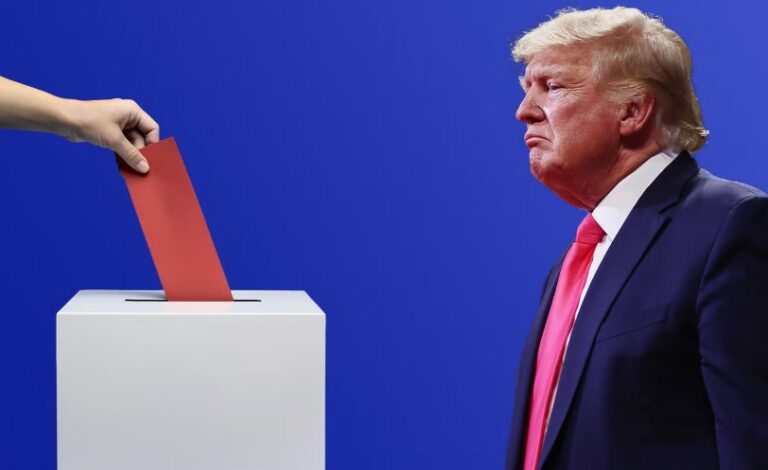
Election Deniers Think the GOP’s Terrible Midterm Polling Is a ‘Psyop’ – The 2026 U.S. midterm elections are still weeks away, but the political battle is already being fought over something that does not appear on any ballot: the meaning of the polls. Recent surveys have shown a difficult political environment for Republicans, with Democrats holding advantages in several national and state-level measures. Rather than accepting those numbers at face value, some prominent figures in the MAGA and election-denial ecosystem are arguing that the polls themselves are part of a deliberate psychological operation, or “psyop,” designed to discourage conservative voters from turning out.
That argument has gained attention after President Donald Trump repeatedly dismissed unfavorable polling as “fake.” Conservative figures have echoed the claim, suggesting that negative numbers are intended to convince Republicans that victory is impossible and therefore reduce their motivation to vote. The debate matters because polling has become much more than a collection of numbers. In an increasingly polarized political environment, polls can influence fundraising, media coverage, campaign strategy, voter enthusiasm and expectations about an election that has not happened yet.
Why Republicans Are Looking at Tough Poll Numbers
There is genuine evidence that Republicans are facing a challenging polling environment as the November midterms approach. A July Pew Research Center survey found Democrats holding a six-percentage-point advantage over Republicans among registered voters on the generic congressional ballot, 43% to 37%. The same Pew report found that economic concerns were prominent among voters heading into the midterms.
More recent polling has continued to produce encouraging numbers for Democrats in several competitive states. The Washington Post reported on October 2 that surveys showed narrow Democratic advantages in Senate contests in Michigan, Iowa and Texas, while another poll showed a larger Democratic lead in Michigan. At the same time, the results varied considerably by race and methodology, and several of the contests remained close enough that relatively small polling errors could matter.
That last point is important. A poll is not a prediction carved in stone. It is a measurement of voter attitudes at a particular moment. Samples can differ, turnout models can be wrong and voters can change their minds. But there is a major difference between saying that polls can be inaccurate and saying that polling organizations are coordinating a psychological operation. Those are two very different claims.
The “Psyop” Argument Takes Shape
Kevin Roberts, president of the conservative Heritage Foundation, gave one of the clearest versions of the argument during a September 28 appearance on Fox Business. Roberts acknowledged that the political environment was difficult for Republicans but argued that some polling and political forecasting amounted to a “psyop” intended to depress conservative turnout. Election Deniers Think the GOP’s Terrible Midterm Polling Is a ‘Psyop’
He also said he believed Republicans could still perform strongly in both chambers of Congress. His comments were subsequently echoed by other conservative media personalities. Former Trump adviser Steve Bannon similarly described the idea of a coming Democratic wave as a “psyop,” while encouraging conservatives not to be discouraged by what the media and polling organizations were reporting. Other influential MAGA accounts have gone further, simply declaring that polls are fake or claiming that negative numbers are part of a coordinated attempt to convince Republicans that their candidates cannot win.
The theory follows a familiar pattern. If Republicans believe that they are losing, the argument goes, some may stay home. If they stay home, Democrats benefit. Therefore, portraying Republicans as behind could itself become a political weapon. There is an intuitive logic to that argument: expectations can affect political behavior. What is missing, however, is evidence establishing that the current polling is collectively being manufactured for that purpose.
Polls Can Be Wrong Without Being a Conspiracy
Political polling has certainly had problems. The 2016 and 2020 presidential elections demonstrated how difficult it can be for pollsters to accurately model the electorate. Differences in turnout, education levels, enthusiasm and voter composition can produce substantial errors. That history gives voters a legitimate reason to treat individual polls cautiousl. But polling uncertainty is not the same thing as evidence that polls are intentionally fabricated.
Different polling organizations use different methodologies, samples and weighting systems. Some surveys interview registered voters; others attempt to model likely voters. Some conduct interviews by telephone, while others use online panels. Results can therefore differ even when pollsters are honestly attempting to measure the same electorate. That is one reason why analysts generally look at groups of polls rather than treating a single survey as definitive. And there is another piece of evidence worth considering: Republicans themselves appear to be responding to internal concerns about competitive races.
Reuters reported in September that Republican groups were directing substantial resources toward dozens of House contests that had previously been considered relatively safe. The increased spending followed internal polling and other assessments suggesting that some races were more competitive than expected. That does not prove that public polls are correct. Internal campaign polling can also be wrong. But it does show that concern about the political environment is not confined to Democratic campaigns or mainstream media organizations.
The Bigger Problem Is Trust
The argument over polling is part of a much larger crisis of confidence surrounding American elections. Pew Research Center reported in August that 55% of Americans were confident that the 2026 midterm elections would be conducted fairly and accurately. That was down from 61% before the 2024 election and 64% before the 2022 midterms. Interestingly, the partisan gap in confidence over whether the election would be conducted fairly was relatively small in the July 2026 survey: 55% of Republicans and Republican-leaning independents expressed confidence, compared with 58% of Democrats and Democratic-leaners. Election Deniers Think the GOP’s Terrible Midterm Polling Is a ‘Psyop’
Other concerns remain sharply partisan. A September survey from Harvard’s Shorenstein Center and the Civic Health and Institutions Project found that 36% of Republicans identified ineligible voters or voter fraud as their single biggest concern about the 2026 elections, compared with 6% of Democrats. The survey included more than 16,000 respondents.
Gallup also found substantial concern about election processes. In a survey of more than 23,000 U.S. adults conducted between April and June, 67% said they were concerned about political leaders pressuring election officials to change election outcomes, while 57% were concerned about ballots not being properly handled, counted or secured. In that environment, skepticism can spread quickly. A voter who already distrusts political institutions may see a disappointing poll not as information that needs to be evaluated, but as proof that someone is trying to manipulate them.
What Voters Can Actually Learn From the Numbers
The simplest way to understand the current polling is also the least dramatic: Republicans are facing some difficult numbers, but the election has not been decided. A poll showing a candidate ahead by a few points does not guarantee victory. A national generic-ballot margin does not translate directly into congressional seats. And historical polling errors mean that today’s measurements should not be treated as precise forecasts of November’s results.
At the same time, there is currently no evidence establishing that unfavorable Republican polling is collectively a coordinated “psyop.” The claim remains an assertion made by political figures and commentators who are skeptical of the polling. That distinction matters.
Voters can reasonably question methodology, examine sample sizes, compare multiple surveys and look at how pollsters have performed historically. They can also recognize that campaigns have incentives to portray the political environment in ways that motivate their supporters. What the available evidence does not justify is automatically treating every unfavorable poll as fraudulent simply because the result is politically inconvenient. The midterms will eventually provide something polls cannot: actual votes. Election Deniers Think the GOP’s Terrible Midterm Polling Is a ‘Psyop’
Until then, the polling debate will continue to be a battle over interpretation, credibility and voter confidence. For Republicans who believe the numbers are wrong, the most consequential response will not be arguing with every survey. It will be persuading voters that their candidates and policies deserve support. And for everyone watching from the outside, the central lesson may be even simpler: a poll is neither a prophecy nor proof of a conspiracy. It is one imperfect measurement of a political moment that can still change before voters have the final say.
About the Author