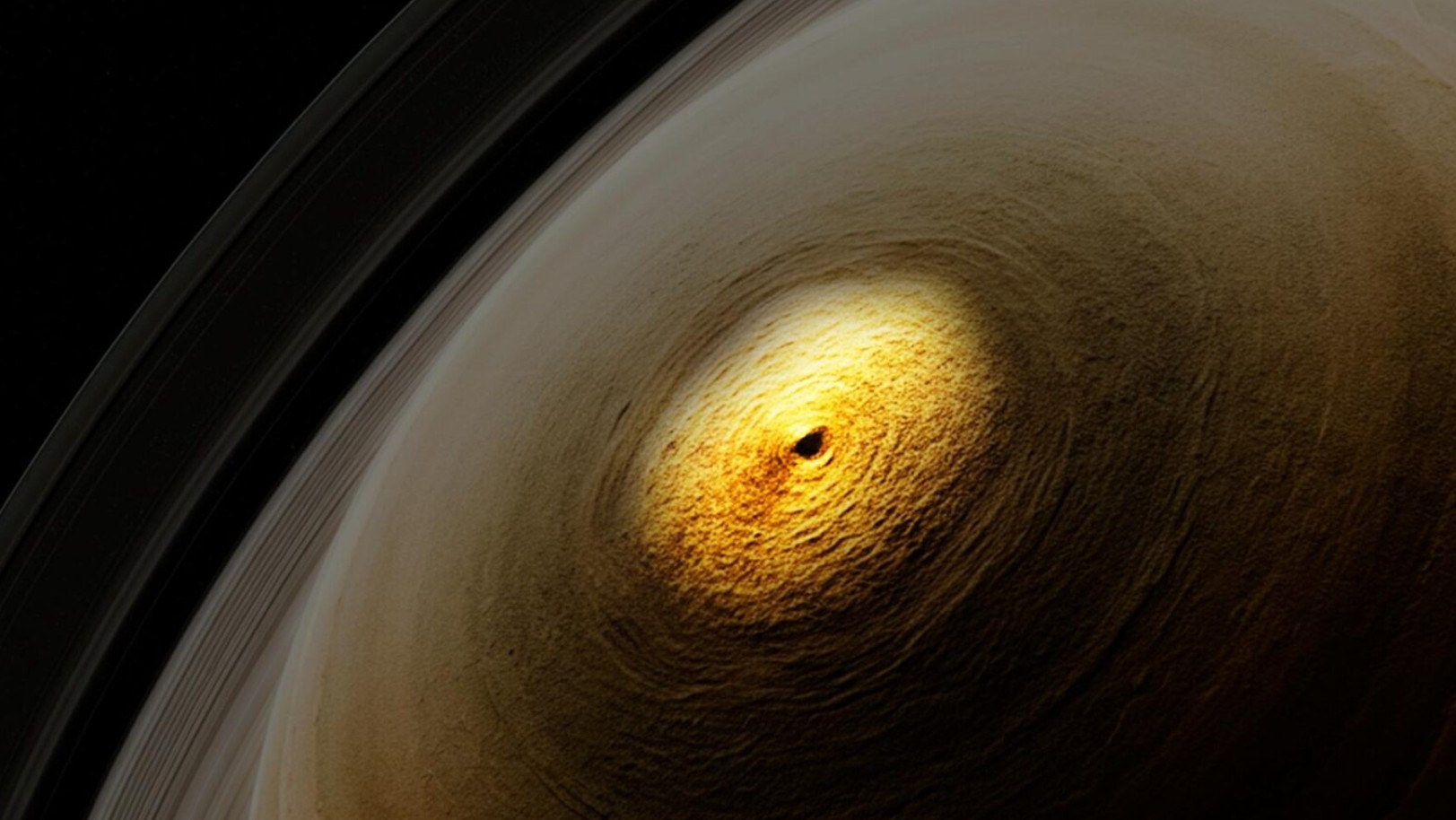
What on earth is going on? On Saturn, Another Perfect Geometric Form Has Been Found – Near Saturn’s south pole, a group of scientists found an odd polygonal atmospheric structure. One of the gas giant’s most well-known characteristics, a hexagon close to the north pole that was originally seen 44 years ago, is joined by this 10-sided structure called a decagon. The Hubble Space Telescope took pictures of the new decagon, and the findings were just released in the journal Science Advances.
Unlike walls or rock formations, the formations at the north and south poles are not substantial structures. Unlike the crust of Earth, Saturn lacks a distinct solid surface. The pressure and density would gradually rise as you descended through the ringed planet’s atmosphere, but you would never come to a “ground” to land on. Rather, astronomers have seen patterns—albeit highly peculiar ones—formed by clouds.
The decagon’s sides are roughly 16,800 kilometers long, a few thousand miles longer than Earth’s diameter. A jet stream that can reach speeds of 116 meters per second, or over 260 miles per hour, is located close to the feature. In contrast, winds above 157 miles per hour are indicative of a Category 5 hurricane, which is the strongest storm level on Earth. It’s interesting to note that the decagon pattern changes at a paltry 2.5 meters per second, or less than 6 miles per hour, despite the jet stream’s enormous speed.
An image of the fresh decagon at the south pole of Saturn
Image courtesy of the Office of Public Outreach at the Space Telescope Science Institute
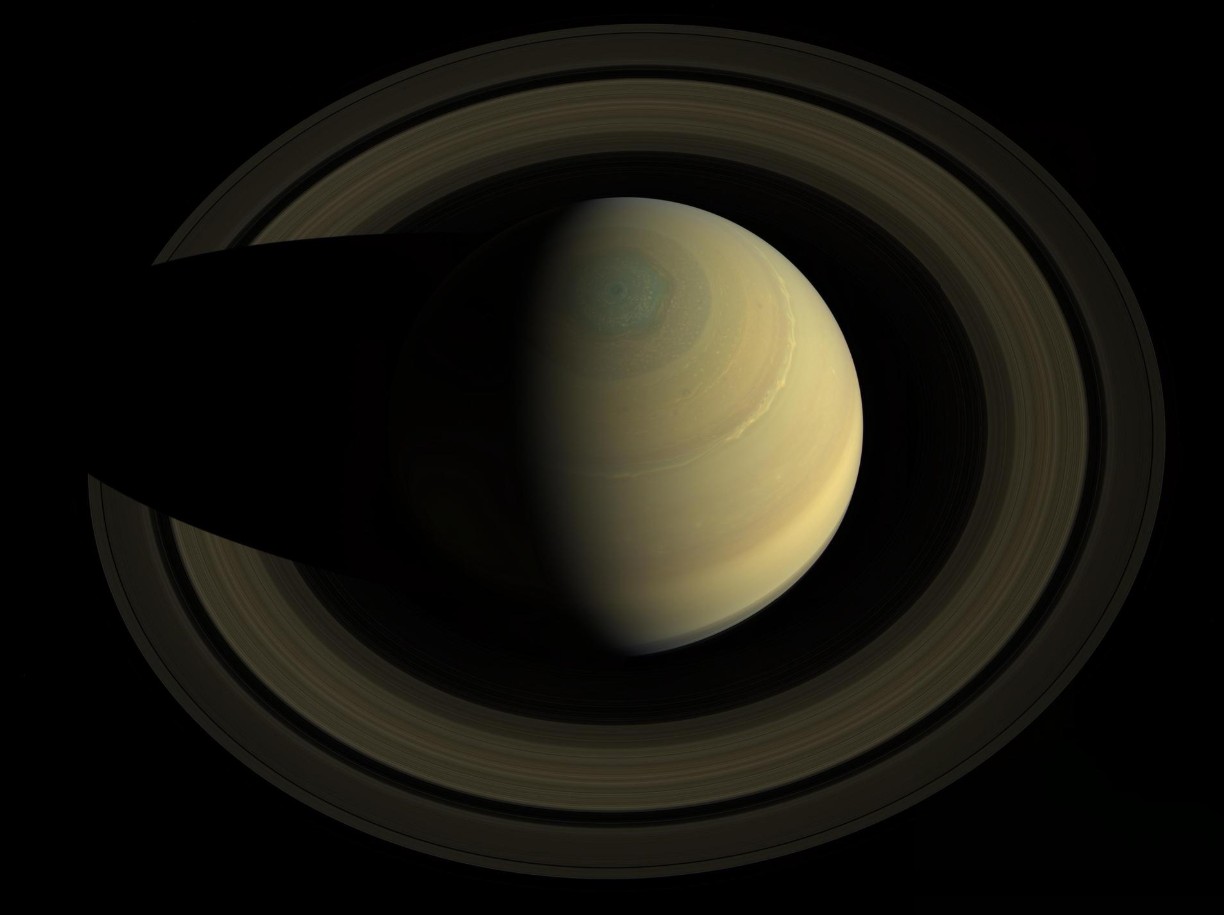
It looks like the south pole feature formed recently. Scientists have been looking for a match for the well-known northern hexagon for many years. However, no comparable, long-lasting structure has ever been discovered in the south by major missions that have surveyed the planet. Saturn’s tilt made it difficult to see its southern hemisphere from Earth for many years, which made the hunt even more difficult.
Ground-based observations, some made by amateur astronomers, provided the initial hints about the decagon. As the pictures mounted, it became clear that Saturn’s southern cloud bands were experiencing an unusual phenomenon. The pattern could be traced back to photos taken in 2023 using data from the Hubble Space Telescope. The presence of a new polygonal feature in the ringed planet’s atmosphere was confirmed by monitoring, which continued until 2025, when its ten vertices were much more precisely delineated. However, science is still unable to provide a satisfactory explanation for the formation of these structures.
Since the north polar hexagon was discovered, a number of theories have been put forth. One is that the polygons are the outward expressions of massive atmospheric waves that are contained by strong jet streams. These can be compared to ocean waves, which are disturbances spreading through the sea rather than just items moving over the ocean.
The space in which a wave travels and the boundaries it comes into contact with alter its behavior. Waves of atmospheric gasses on Saturn might be coming into contact with jet streams that, like a beach’s edge, contain them. In this instance, however, the “beach” encircles the entire planet.
About the Author