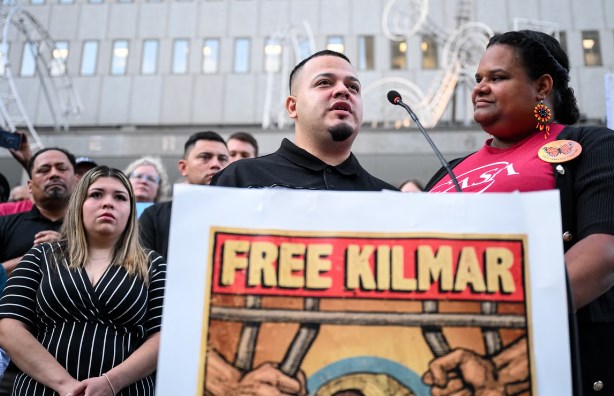
Abrego Garcia was a symbol in Trump’s immigration battle – For nearly two years, the name Kilmar Ábrego García carried weight far beyond a single immigration file. To critics of President Donald Trump’s mass-deportation campaign, he became a human face for due process, court authority, and family separation. To the administration and its defenders, his case became a test of executive power, border enforcement, and how far the federal government could go to remove people from the country.
His departure from the United States to Spain in late November 2026 marked a major turning point in a saga that stretched from a Maryland family life to a Salvadoran mega-prison, federal courtrooms, and the U.S. Supreme Court. Even as he stepped off a plane in Madrid, the battle over what his case represented remained fiercely contested.
A Protected Life Upended in March 2025
Ábrego García grew up in El Salvador and came to the United States illegally as a teenager around 2011 after fleeing gang threats. In 2019, an immigration judge ruled that he could not be deported back to El Salvador because of the danger he faced there, allowing him to live and work in the U.S. under supervision while married to an American citizen and raising a child in Maryland.
That fragile stability broke in March 2025. Following his arrest in Maryland, federal authorities placed him on a flight to El Salvador as part of a high-profile deportation push linked to an agreement with Salvadoran President Nayib Bukele’s government to house deportees at the notorious CECOT facility. Abrego Garcia was a symbol in Trump’s immigration battle
For civil rights advocates and legal observers, the removal stood out because Ábrego García had a court protection order against deportation to El Salvador and had not been given a hearing before a judge prior to being flown out. Government officials initially pointed to an administrative error while also disputing his background, turning a single deportation into an immediate flashpoint over constitutional safeguards.
Courts, Defiance, and a High-Stakes Return
As news of the removal spread, Ábrego García’s case quickly escalated into a clash between the executive branch and the judiciary. Federal judges scrutinized how the removals were carried out, and the U.S. Supreme Court weighed in on the administration’s obligations regarding his return.
Lawmakers, including Maryland Senator Chris Van Hollen, drew national attention to his detention in El Salvador, framing his plight as a warning about unchecked executive power. Meanwhile, administration officials pushed back forcefully, arguing that courts were overstepping and insisting they were acting firmly against illegal immigration and security threats. Abrego Garcia was a symbol in Trump’s immigration battle
Months after his March 2025 deportation, Ábrego García was brought back to the United States following Supreme Court action—only to face a new set of legal battles. Criminal charges brought in Tennessee later collapsed when a federal judge dismissed the case over selective or vindictive prosecution, even as the government pursued efforts to deport him to third countries rather than allow him to remain freely in the U.S.
Third-Country Deportations and a Departure to Spain
Rather than letting the dispute end quietly, the second phase of the clash centered on where Ábrego García could be sent. While his legal team sought options such as Costa Rica, administration officials pressed to send him to African nations, reflecting a broader push toward third-country removals.
That standoff shifted ahead of the November 24, 2026 deadline set by U.S. District Judge Paula Xinis. Under terms allowing him to depart unimpeded to a country willing to accept him—and with his GPS ankle monitor ordered removed—Ábrego García chose to travel to Spain rather than face forced removal to Africa.
His attorney described the move as a temporary departure with hopes of eventually reuniting with his family in Maryland under a future administration. The Department of Homeland Security and administration allies treated his exit as a vindication of their enforcement pressure, while supporters emphasized that he left on his own terms rather than in shackles. Abrego Garcia was a symbol in Trump’s immigration battle
Why the Symbol Endures
Even with Ábrego García out of the country, his case remains etched into the history of America’s immigration debates. It exposed the friction between rapid, aggressive deportation policies and the slow, rule-bound machinery of American courts.
For some, his story shows how vulnerable immigrants—even those with court protections and American families—can become when national politics turns enforcement into a spectacle. For others, it reflects a government determined to test legal boundaries and reshape immigration rules without hesitation. Either way, Kilmar Ábrego García’s name became shorthand for a deeply divided era in U.S. immigration policy. Abrego Garcia was a symbol in Trump’s immigration battle
About the Author