JD Vance says Trump’s post of himself as Jesus was a joke – After defending a contentious social media post by Donald Trump that portrayed the previous president in the image of Jesus Christ, U.S. Senator JD Vance has sparked a new discussion about political hyperbole, humor, and the limits of public discourse. The event has sparked a wider discussion on satire, religious sensitivity, and the changing tone of contemporary political communication, despite Vance dismissing the tweet as “a joke.”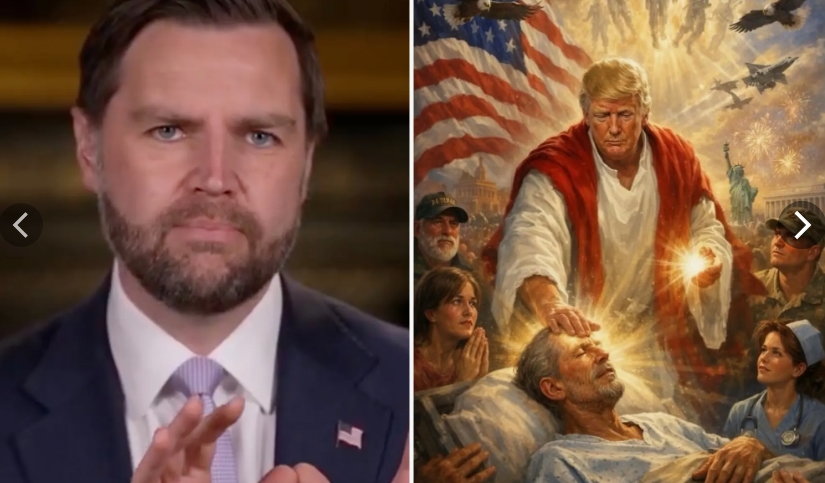
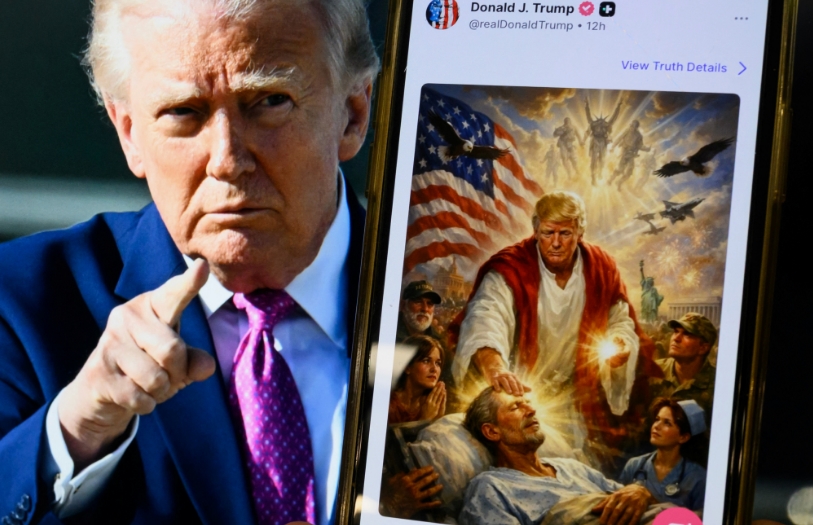
When Trump posted an AI-generated picture of himself using iconography typically associated with Jesus Christ, the uproar started. Both admirers and detractors reacted sharply to the message as it swiftly went viral on social media. Given the religious symbolism involved, some people found it insulting or improper, while others thought it was funny or representative of Trump’s unusual style. The divisive responses are a reflection of deeper cultural differences on the place of religion and satire in public life as well as attitudes toward Trump himself.
Vance attempted to minimize the commotion when speaking to reporters. He maintained that the tweet was intended to be humorous and in line with Trump’s frequently controversial online character rather than to be taken seriously or reverently. Vance claimed that detractors were exaggerating and failing to understand the purpose of the post. He presented the backlash as part of a larger trend in which political rivals exploit humorous or exaggerated moments to incite indignation.
Vance’s case draws attention to a crucial aspect of modern politics: the fusion of humor, entertainment, and administration. More than other contemporary politicians, Trump has developed a style that blurs these lines. Memes, exaggerated images, and lighthearted commentary are common features of his social media presence. His fans find this strategy to be novel and genuine, a departure from what they consider to be excessively staged political rhetoric. However, it might come across as insensitive or even insulting to his critics, especially when it deals with delicate subjects like religion.
An additional level of complication was introduced by the post’s reference to Jesus Christ. For millions of individuals, religious imagery has deep significance, and its application in political circumstances frequently draws criticism. Critics contended that equating a prominent religious figure with a political figure, even in fun, runs the risk of trivializing sincerely held convictions. Regardless of the intention, some religious leaders and observers voiced worry that such imagery would be interpreted as disrespectful or blasphemous.
Trump supporters, however, tended to read the article in a different way. Many saw it as a humorous critique of his detractors’ portrayal of him or the fervent allegiance of his supporters. According to this interpretation, the image was more about making fun of the inflated stories surrounding Trump’s political career than it was about comparing him to Jesus Christ. Vance’s comments, which prioritized humor over precise meaning, were in line with this perspective.
The program also highlights how AI-generated content is becoming more and more influential in political discourse. The image in question was a digitally produced representation that made use of artificial intelligence techniques rather than a conventional photograph or graphic. This begs the question of how future political messages will be influenced by such technology. AI-generated graphics are useful tools for both satire and disinformation because they can be remarkably accurate or purposefully overblown. The distinction between parody and deceit may become more challenging to make as these technologies proliferate. JD Vance says Trump’s post of himself as Jesus was a joke
Vance’s reaction makes sense in light of his political affiliation with Trump. Vance, a well-known Republican and the former president’s ally, has regularly spoken up for Trump in the face of criticism. In addition to reflecting his own perception, his portrayal of the post as a joke is a calculated attempt to reduce controversy and preserve party unity. Vance directs attention away from the post’s content and toward the responses it sparked by characterizing the problem as exaggerated.
The event also highlights the difficulties public figures face in a day of immediate communication. Every message is amplified by social media platforms, which enable posts to reach millions of people in a matter of minutes. Both humor and controversy can be amplified by this quick spread, which frequently leaves little opportunity for subtlety. What was formerly thought to as a short-lived or specialized joke might soon turn into a national or even international controversy.
The varying responses to Trump’s article also demonstrate how cultural context influences interpretation. Exaggerated imagery and irreverent humor are allowed, even admired, in some communities. Others may find such things unpleasant or improper, especially those with strong religious backgrounds. It is challenging to come to a consensus on what constitutes appropriate satire because of these divergent viewpoints.
Furthermore, the episode calls into question the duties of political leaders on a larger scale. Even in joke, should public personalities use religious iconography with more caution? Or should they be allowed to use satire without worrying about criticism? There is no simple solution since it is difficult to strike a balance between respect for cultural and religious values and freedom of expression. JD Vance says Trump’s post of himself as Jesus was a joke
Reframing the story and protecting a political ally seem to be Vance’s top priorities. He tries to deflect criticism and divert attention by calling the message a comedy. The audience has a big influence on how successful this strategy is. Trump’s supporters will probably accept the answer and move on, but his detractors might think it dismisses valid concerns.
Ultimately, the post’s debate represents a microcosm of the larger conflicts in contemporary political discourse. It serves as an example of the unexpected ways in which humor, technology, and firmly held ideas can interact. It also draws attention to the difficulties of communicating in the digital age, when purpose and interpretation might differ significantly.
Such occurrences are likely to increase in frequency as political personalities continue to negotiate this terrain. Social media, AI-generated material, and a sharply divided audience combine to create a setting where a single image can cause a great deal of controversy. Trump’s post—and Vance’s defense of it—offers an insightful look at how politics are changing in the twenty-first century, regardless of whether it is seen as lighthearted or excessive. JD Vance says Trump’s post of himself as Jesus was a joke
About the Author