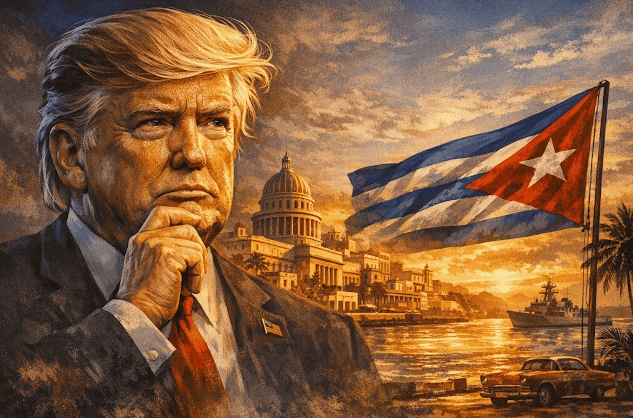
Trump eyes surprise economic deal with Cuba – A unexpected new development in American foreign policy discussions is emerging as Donald Trump reportedly considering a major economic venture involving Cuba. The plan, still in early exploratory stages according to many political insiders, might constitute a radical turnaround in how the United States approaches economic engagement with the island nation after decades of hostility, sanctions, and political mistrust.
For more than sixty years, ties between the United States and Cuba have been marked by conflict, embargoes, and ideological rivalry. Since the aftermath of the Cuban Revolution in 1959, successive U.S. administrations have mostly maintained economic sanctions aimed at isolating the communist government in Havana. However, Trump’s stated openness in exploring an economic arrangement—potentially centered on trade, investment, and infrastructure—signals that a pragmatic recalculation may be beginning.
A Strategic Economic Opportunity
The alleged idea would involve opening restricted commercial channels between the United States and Cuba in sectors such as agriculture, tourism infrastructure, and energy development. Analysts think the decision might generate substantial economic prospects for both countries.
Cuba’s economy has struggled for years due to sanctions, falling tourism earnings, and structural economic issues. Limited access to international financing and investment has further hindered economic growth. American corporations, however, have long considered the Cuban market as an untapped possibility due to its proximity—just 90 miles from Florida—and its demand for consumer goods, construction materials, and agricultural products.
Trump’s economic advisers are said to be studying ways the United States may benefit commercially while keeping political influence. A carefully constructed pact may allow American exporters and investors to access sectors of the Cuban economy that sorely require modernization, like ports, telecommunications, and renewable energy. Such an arrangement would indicate a realistic pivot from the extreme measures often associated with Trump’s first presidency.
A Contrast With Previous Policy
During his time in office, Trump revoked key engagement programs enacted by Barack Obama. The Obama administration had launched a historic thaw in ties between the United States and Cuba, including reopening embassies and lifting some travel and commerce restrictions in 2015.
Trump then increased several of those sanctions, citing human rights concerns and the Cuban government’s support for authoritarian friends. However, political dynamics and economic realities may now be pushing a reassessment.
Supporters of the new approach claim that economic participation, rather than isolation, might create leverage while also enabling Cuban residents acquire better economic opportunities. Critics, however, warn that financial engagement could bolster the Cuban government without leading to significant political transformation.
Political Calculations at Home
Domestic politics could also play a role in Trump’s apparent willingness to a limited compromise. Cuban-American voters, particularly in Florida, have long supported severe policies toward Havana. Yet sentiments within younger generations are progressively turning toward pragmatic participation that helps regular Cubans.
By suggesting an economic effort rather than full diplomatic normalization, Trump may attempt to strike a political balance: exerting pressure on the Cuban leadership while showing himself as a dealmaker capable of unlocking economic prospects.
For Trump, who established his political identity on negotiating large-scale agreements, the potential of a headline-grabbing economic pact with a longtime geopolitical enemy might carry symbolic weight. It would also suit his broader narrative of favoring American corporate interests abroad.
What a Deal Might Look Like
Although no official plan has been announced, policy analysts think numerous frameworks are viable if negotiations were to commence. One alternative would be a tailored trade pact allowing U.S. agricultural exports to expand significantly into the Cuban market. American farmers have long lobbied for this move, noting that the island imports billions of dollars in food each year that could easily come from nearby U.S. producers.
Another alternative is infrastructure agreements. American engineering and construction businesses might potentially help rebuild Cuban ports, airports, and logistical networks, which have suffered from decades of underinvestment.
Tourism-related investment is another subject commonly studied by economists. If limitations were partially removed, U.S. hospitality corporations could invest in hotels and resorts around Cuba, creating jobs and expanding tourism choices for Americans.
Energy cooperation might also play a role, particularly in renewable energy projects such as solar and wind power—areas where Cuba has shown significant interest as it strives to minimize dependency on imported fuel. Trump eyes surprise economic deal with Cuba
Challenges and Skepticism
Despite the economic logic supporting collaboration, the path toward any deal would certainly be complex. U.S. sanctions rules affecting Cuba remain comprehensive and would require congressional involvement to drastically alter. Political opposition could develop from MPs who fear cooperation would reward the Cuban leadership without obtaining democratic improvements.
Human rights organizations may also raise concerns about whether economic investment would benefit ordinary citizens or primarily state-controlled enterprises. Additionally, the Cuban government itself might approach negotiations warily. Havana has generally avoided deals that could be viewed domestically as concessions to Washington. Still, some experts say economic necessity could force both sides toward reasonable agreement. Trump eyes surprise economic deal with Cuba
A Regional and Global Context
Any adjustment in U.S.–Cuba ties would have broader strategic ramifications across Latin America. The long-standing U.S. embargo against Cuba has often been challenged by regional states, many of whom retain normal diplomatic and trade relations with Havana.
If Trump were to pursue even a partial economic opening, it might shift regional dynamics and decrease one of the longest-running diplomatic tensions in the Western Hemisphere. The move might potentially alter Cuba’s relationships with global partners like as China and Russia, both of which have developed economic and strategic ties with Havana in recent years. By re-engaging economically, the United States might reclaim influence in an area where geopolitical competition has risen. Trump eyes surprise economic deal with Cuba
Uncertain Road Ahead
At this stage, the idea of an economic deal remains hypothetical. Neither Trump nor Cuban officials have formally acknowledged conversations. However, the topic alone has already provoked disagreement among policymakers, economists, and political experts. If the notion proceeds forward, it might mark one of the more unexpected foreign policy shifts in years—especially considering the traditionally poor ties between the two nations.
For now, observers are waiting intently to see whether Trump’s reputation as an unusual negotiator will lead to a new chapter in U.S.–Cuba ties. Should such an agreement materialize, it could affect trade flows, political dynamics, and diplomatic ties across the Americas—potentially changing a rivalry that has endured for more than six decades into an economic alliance rooted on pragmatic interests. Trump eyes surprise economic deal with Cuba
About the Author