Republicans can stop following Trump whenever they want – For nearly a decade, Donald Trump has retained an amazing grasp over the Republican Party. His influence has impacted not simply policy ideas but also the tone, objectives, and identity of the GOP itself. Yet one truth often goes unstated in political discourse: Republicans are not bound to Trump by law, oath, or destiny. They can opt to move on at any time. The true story is not about whether they can break away—but why so many have opted not to.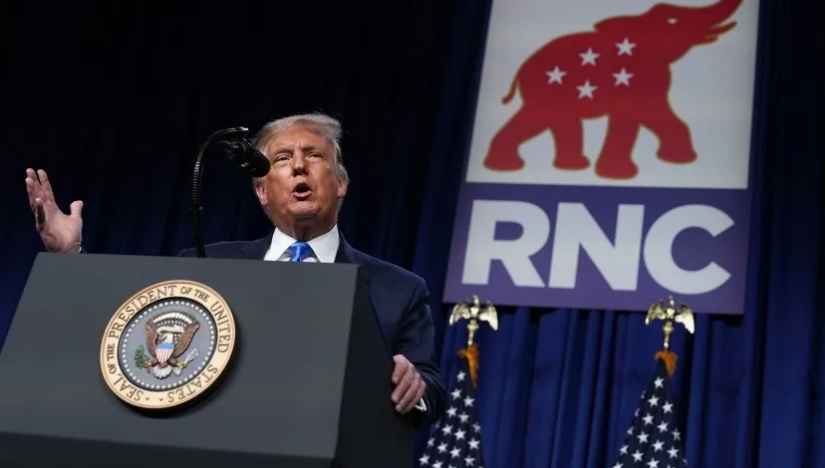
At its foundation, political loyalty is a matter of incentives. Elected politicians respond to voters, donors, and party structures that determine their political survival. Trump’s continued popularity among a sizable percentage of Republican voters has made him more than just a past president—he has become a litmus test. For many GOP leaders, aligning with Trump is not merely about agreement; it is about avoiding retribution. Primary elections, where turnout is often driven by the most engaged—and frequently the most ideologically committed—voters, have become a potent mechanism strengthening Trump’s supremacy.
This dynamic has generated a feedback loop. Republican supporters who firmly support Trump elect politicians that echo his beliefs. Those candidates, in turn, promote Trump’s messaging, further solidifying his influence inside the party base. Breaking that loop demands political boldness, but more crucially, it requires a shift in voter mood. Politicians rarely lead revolutions within their own parties; more frequently, they follow them.
Still, it would be misleading to claim that Republicans are wholly powerless. There have been occasions when GOP leaders have pushed back against Trump, particularly in the aftermath of controversial incidents. Some high-profile figures have openly opposed him, believing that his strategy has lost the party electorally or hampered its long-term chances. However, these periods of resistance have frequently been short-lived or limited in scope. The consequences—loss of support, political isolation, or primary challenges—have offered as cautionary tales for those choosing a similar path. Republicans can stop following Trump whenever they want
One of the most fundamental elements keeping Republicans together with Trump is the fear of division. Political parties are coalitions, and unity is generally considered as necessary to winning elections. For many GOP officials, breaking with Trump risks dividing the party at a time when togetherness is considered as crucial. This concern is not unjustified. History suggests that split parties often struggle at the voting box. But unity constructed on avoidance rather than actual accord can come at a cost, particularly when it stifles debate and discourages new ideas.
Another layer to this issue is the shift of media and information ecosystems. Conservative media outlets and online platforms have played a considerable role in amplifying Trump’s voice and structuring political storylines in ways that resonate with his fans. This milieu makes it more difficult for dissenting Republican voices to gain momentum. When different ideas are ignored or depicted as disloyal, the opportunity for internal debate diminishes substantially.
Yet, behind the surface, there are hints of stress. Some Republicans worry about the long-term survival of a party so strongly attached to a single figure. They point to election defeats, changed demographics, and changing voter priorities as grounds to reassess the current direction. These concerns are generally addressed softly, in private talks rather than public comments. The reticence to talk frankly underscores the tremendous risks involved—both politically and personally.
It is also crucial to remember that the Republican Party is not homogeneous. It comprises a wide spectrum of opinions, from traditional conservatives focused on fiscal policy and limited government to populist voices invigorated by Trump’s rhetoric. This diversity means that any shift away from Trump would not be uniform or rapid. Instead, it would likely unfold gradually, affected by electoral outcomes, generational change, and evolving voter opinions. Republicans can stop following Trump whenever they want
The question of whether Republicans will finally move on from Trump is strongly related to the broader question of what the party wants to be. Is it a movement characterized primarily by one leader, or is it a coalition based around a set of timeless principles? Answering that question involves more than strategic calculation; it demands introspection and a willingness to participate in tough conversations.
Critics often portray the problem as one of courage—suggesting that Republicans just need to stand up and break away. While there is some validity to that approach, it oversimplifies a complex reality. Political decisions are rarely made in a vacuum. They are formed by pressures from constituents, party leaders, and the greater political climate. Expecting a rapid, communal split may be unreasonable. Change, if it happens, is more likely to emerge incrementally.
There is also the problem of accountability. In a democratic system, officials ultimately answer to voters. If Republican voters continue to back Trump and candidates affiliated with him, the incentives for change remain limited. Conversely, if voter preferences shift—if there is a rising appetite for new leadership or a different direction—politicians will respond accordingly. In this sense, the power to reform the party does not lay simply with its leaders; it resides with its electorate. Republicans can stop following Trump whenever they want
Looking ahead, various things could influence the future of the Republican Party. Electoral outcomes will play a big effect. Success may support the present approach, while losses could provoke reevaluation. Generational change is another major aspect. Younger voters and future leaders may offer fresh goals and viewpoints, potentially changing the party’s identity over time.
Ultimately, the concept that Republicans are “stuck” with Trump is more myth than fact. They have agency. They have alternatives. But those decisions come with implications, and managing them demands combining short-term political considerations with long-term strategic aims. The way forward is not predetermined; it will be shaped by the decisions of voters, leaders, and the party as a whole. Republicans can stop following Trump whenever they want
In the end, the story is less about Trump himself and more about the Republican Party’s relationship with its own base. As long as Trump is a dominating figure among Republican supporters, his impact will persist. But political environments can shift, often swiftly. When they do, the incentives that guide politicians will alter as well. Republicans can stop following Trump whenever they want. The real question is not whether they can—but when, how, and at what cost they are ready to do so.