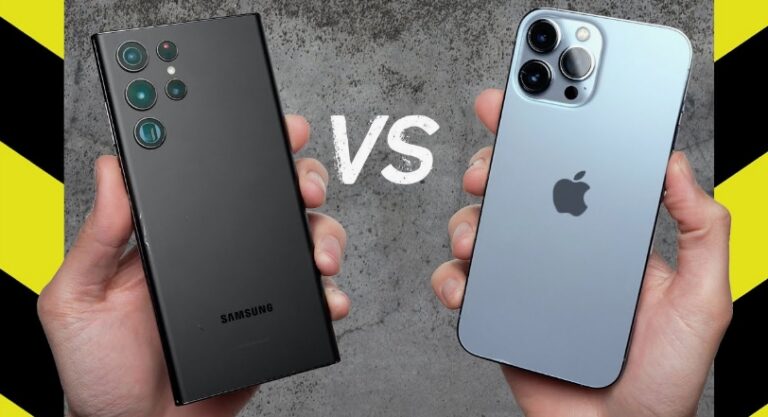
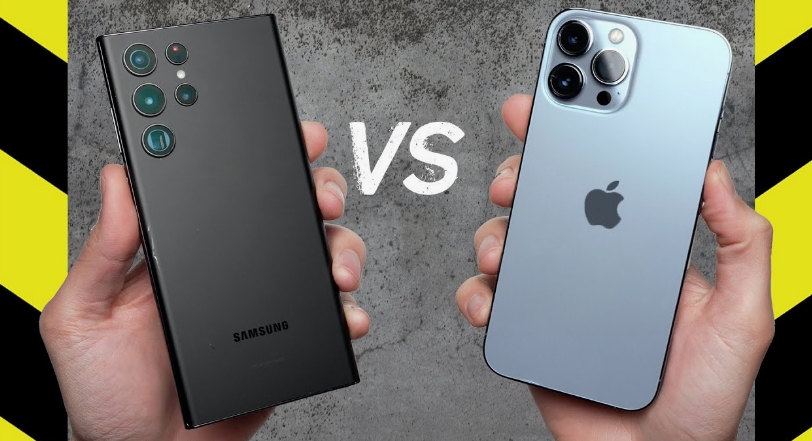
Galaxy S26 Ultra vs. iPhone 17 Pro Max: Which ,300 flagship deserves to be in your pocket? – The Galaxy S26 Ultra just landed, Samsung’s most capable phone yet — and it’s marching straight into a confrontation with the iPhone 17 Pro Max, which has been quietly making Apple supporters quite smug since last September. One runs Android, one runs iOS, both cost over a thousand dollars, and exactly one of them is appropriate for you. Here’s how to figure out which.
Price and availability
The S26 Ultra is $1,300 for 256GB and $1,800 if you want the 1TB with 16GB RAM. The regular S26 and S26+ both got $100 pricier this year – the Ultra strangely dodged that fate. Samsung’s rationale there isn’t hard to figure out. Neither packaging includes a charger inside. With the iPhone 17 Pro Max, $1,199 buys you 256GB, and if you somehow require 2TB on a phone, that’ll pay you $1,999. Both firms know this and don’t care. Trade-ins help — Apple’s been providing up to $700 back, Samsung had up to $900 off during pre-orders. Run those numbers before you pay full price.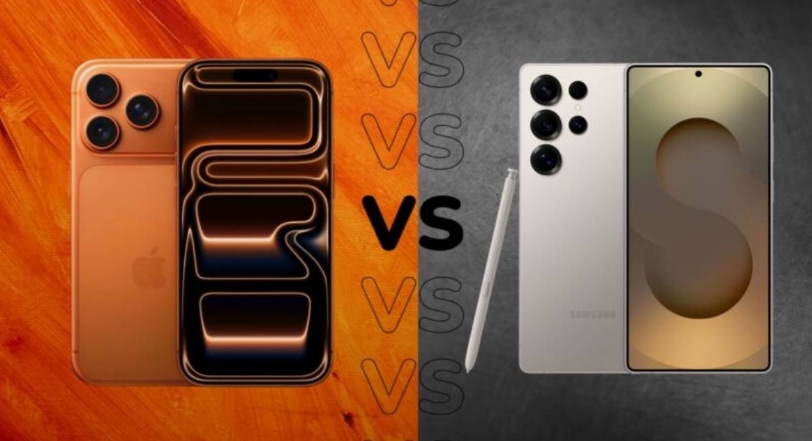
Samsung and Apple both made the switch to aluminum this year, which is either a coincidence or proof that great minds think alike. The S26 Ultra is 163.6 x 78.1 x 7.9mm and weighs 214 grams, while the 17 Pro Max is just a hair shorter and narrower at 163.4 x 78.0 x 8.75mm, but heavier at 233 grams. That 19-gram difference adds up — especially if you’re the kind to stay on your phone long beyond when you said you would.
Samsung chose with Gorilla Armor 2 on the screen and Gorilla Glass Victus 2 on the back, sitting in an Armor Aluminum frame. Apple’s side of the story is Ceramic Shield 2 on the screen and the older Ceramic Shield on the back — the kind that’s withstood more drops than most people care to acknowledge.
Apple iPhone 17 Pro in Cosmic Orange next to the iPhone 17 Pro Max in Deep Blue
Samsung handed out Black, Cobalt Violet, Sky Blue, and White, with Silver and Pink Gold sitting behind the velvet rope on the official website. Apple kept it to three: Cosmic Orange, Deep Blue, Silver. They removed black totally, and the internet accepted that news about as gracefully as you’d imagine.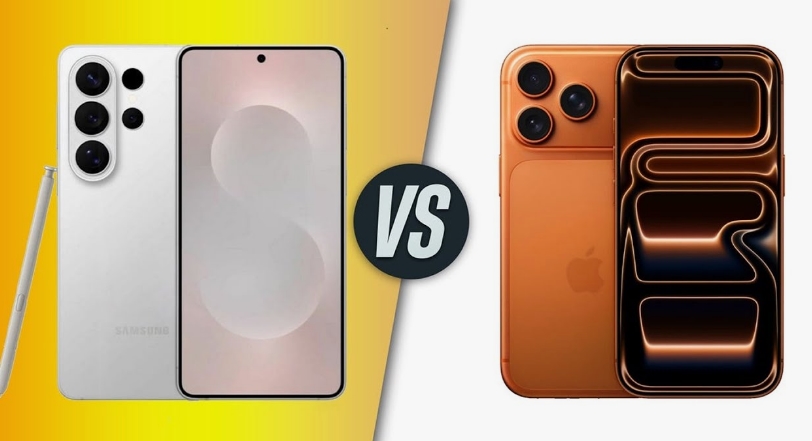
Both phones are IP68, albeit the fine print says differently. Apple’s rated down to 6 meters, Samsung stops the guarantee at 1.5. In practice, neither rating protects you for a saltwater swim or a dive with the fish.
Samsung Galaxy S26 Ultra
Same screen size, same refresh rate range – that’s literally where the parallels clock off and go home. Samsung’s tossing a 3210 x 1440 QHD+ Dynamic AMOLED 2X panel at you, peaking at 2,600 nits. Apple’s going 2868 x 1320 at 460 ppi on the Pro Max, and when you pull it outside on a bright day, it’ll go all the way to 3,000 nits. Four hundred nits doesn’t sound like much until you’re standing in a parking lot straining at Google Maps trying to figure out if you turned left or right.
Apple iPhone 17 Pro in Cosmic Orange next to the iPhone 17 Pro Max in Deep Blue
Where Samsung pulls something genuinely fresh out of its sleeve is the Privacy . It’s a first-of-its-kind hardware function embedded straight into the panel – not a screen protector, not trickery. Turn it on and your screen turns dark to anyone not looking straight at it. The iPhone doesn’t have anything close to this.
Talking about unique features, Apple’s answer is the Dynamic Island – still interactive, still handy, still the thing that makes Android users silently envy at coffee shops. Both phones also have always-on and that same buttery 1-120Hz adaptive refresh rate, so scrolling feels identical on both, which is to say: very, very excellent.
Performance Snapdragon 8 Elite Gen 5 for Galaxy spec wall.
Under the hood, the S26 Ultra runs on a bespoke Snapdragon 8 Elite Gen 5 — Samsung and Qualcomm cranked this one out together, prime cores sitting at 4.74GHz. The 17 Pro Max includes Apple’s A19 Pro handling the heavy work, 6 cores, 16-core Neural Engine, and strangely enough, both chips are fabbed using TSMC’s 3nm technology.
Numbers-first folks will enjoy the Samsung. The Snapdragon is 19% quicker on CPU, 24% on GPU, NPU climbs 39% over previous year. Geekbench multi-core? S26 Ultra runs away from the A19 Pro. RAM starts at 12GB, increases up to 16GB if you buy the 1TB version. iPhone stuck at 12GB flat, no alternatives.
Apple A19 Pro in the iPhone Air
So, whether it is day-to-day chores such as accessing applications, watching Reels on Instagram or videos on YouTube, or demanding processes like playing video games at their top settings or editing films on the fly, both phones should give a similarly remarkable experience.
Apple’s whole shtick is doing more with less. The A19 Pro pulls roughly 12W at peak load, while Snapdragon needs closer to 19W to meet its ceiling. Both phones actually have vapor chambers, with different construction, but the same goal: keep the chip from frying itself.
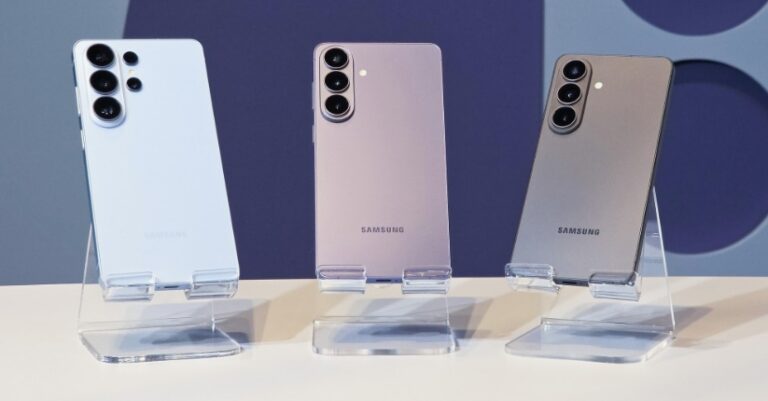
Picture shows three Galaxy S26 seires phones in one frame.
One UI 8.5 is Samsung’s most refined skin to date. Now Nudge scans what’s on your screen and provides suggestions before you even ask. Call Screening handles unfamiliar numbers on your behalf. Audio Eraser, formerly buried in Samsung’s own apps, now works inside YouTube and Instagram. Gemini provides the hard lifting for web-based tasks, while Perplexity joins as a second AI agent this year. Samsung’s also locked in seven big OS upgrades, which is simply more commitment than most people get in other aspects of their life.
Apple iOS 26 operating on the iPhone 16 Pro
iOS 26 is Apple’s largest visual shake-up in years — the Liquid Glass revamp isn’t just a coat of paint, it’s a comprehensive rethink of how the OS looks and feels. Apple Intelligence adds Live Translation into conversations, FaceTime, and Messages, Visual Intelligence works across anything on your screen, and Call Screening does the same job as Samsung’s version, just inside a different ecosystem. The Apple-everything connection still remains – your iPhone, Mac, iPad, and AirPods all just know what the other is doing. Galaxy S26 Ultra vs. iPhone 17 Pro Max
Cameras Samsung Galaxy S26 Ultra
The S26 Ultra shows up with four cameras — a 200MP main that now breathes via an f/1.4 aperture, a 50MP ultrawide, a 50MP periscope at 5x, and a 10MP at 3x. That aperture shift from f/1.7 sounds modest until you’re shooting in a poorly lit restaurant and your shots actually come out looking like photos.
Space Zoom hits 100x on paper, though at 50x you’re basically gazing at abstract art. Video resolution max out at 8K at 30fps, Galaxy AI edits photographs from plain text prompts now, and the 12MP f/2.2 selfie camera shoots 4K at 60fps.
Apple iPhone 17 Pro in Cosmic Orange
The 17 Pro Max went full 48MP on all three back cameras – first time Apple’s done that. The telephoto got the largest glow-up, a brand new sensor that’s 56% chunkier than what was in the 16 Pro Max, sitting behind an f/2.8 aperture. That converts to 4x optical, 8x optical-quality, and 40x digital for when the subject is so far away that your arm definitely isn’t long enough. Galaxy S26 Ultra vs. iPhone 17 Pro Max
Video max out at 4K 120fps in Dolby Vision, ProRes RAW for the individuals who actually know what a color grade is, and Log 2 for anyone constructing a complete workflow around their phone footage. Front camera is where Apple actually caught folks off guard – 18MP, square sensor, snaps landscape selfies while the phone is upright, auto-widens when additional faces step into frame (something that I particularly adore on my iPhone 17).
Battery Life
A Samsung Galaxy S26 Ultra in a man’s hand. The S26 Ultra is still using a 5,000mAh cell – same as last year, same as the year before that. Samsung didn’t boost the storage, but what they did change was charging. It now does 60W connected, up from 45W on the S25 Ultra, which implies 75% in around 30 minutes. Wireless got increased to 25W too, however there’s a caveat – no built-in magnets, so attaining that full speed requires a magnetic casing.
Rear casing of iPhone 17 Pro. The iPhone 17 Pro Max runs a 4,823mAh battery. Apple’s running real-world peak wired charging somewhere around 36-39W depending on whose lab you trust, while MagSafe wireless hits up to 25W with the correct adaptor. The 50% mark takes roughly 20 minutes wired.
Day-to-day, both phones will get most people through without a top-up. Heavy users – the ones with always-on navigation, four hours of screen time before midday, and a podcast playing the whole time — could notice the iPhone holds steadier through hour nine and ten. Galaxy S26 Ultra vs. iPhone 17 Pro Max
Conclusion
Samsung Galaxy S26 Ultra
Get the S26 Ultra if you snap a lot of images in diverse circumstances, want the freedom of Android, use the S Pen (a very important reason to consider the smartphone), or just appreciate having every possible function stuffed into one device. The zoom range alone is a reason to consider it. So is 60W charging if you’re continuously running low at the worst times. Further, the Galaxy AI suit is considerably more useful than Apple Intelligence in its current condition; this also helps the phone justify the $100 premium over the iPhone 17 Pro Max. Galaxy S26 Ultra vs. iPhone 17 Pro Max
Apple iPhone 17 Pro in Cosmic Orange next to the iPhone 17 Pro Max in Deep Blue
Get the iPhone 17 Pro Max if you’re already in the Apple ecosystem, shoot video seriously, or just want a phone that does its job without requiring much thought. The battery longevity, the video quality, and iOS 26 being actually refined this year all make a good case. Galaxy S26 Ultra vs. iPhone 17 Pro Max
About the Author